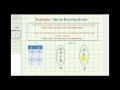
Understanding Functions and One-to-One Functions

Interactive Video
•
Mathematics
•
7th - 10th Grade
•
Practice Problem
•
Hard
Standards-aligned

Jackson Turner
FREE Resource
Standards-aligned
Read more
7 questions
Show all answers
1.
MULTIPLE CHOICE QUESTION
30 sec • 1 pt
What is a function in terms of input and output?
A relation where inputs and outputs are the same
A relation where each input has exactly one output
A relation where each output has multiple inputs
A relation where each input has multiple outputs
2.
MULTIPLE CHOICE QUESTION
30 sec • 1 pt
How can you determine if a function is one-to-one?
Each output has a unique input
Each output has multiple inputs
Each input has a unique output
Each input has multiple outputs
Tags
CCSS.8.F.A.1
3.
MULTIPLE CHOICE QUESTION
30 sec • 1 pt
In the first table, why is the relation not a function?
Because it has more y-values than x-values
Because all y-values are unique
Because all x-values are unique
Because one x-value corresponds to two y-values
Tags
CCSS.8.F.A.1
4.
MULTIPLE CHOICE QUESTION
30 sec • 1 pt
What is the key characteristic of the second table that makes it a function?
Each x-value has multiple y-values
Each y-value has exactly one x-value
Each x-value has exactly one y-value
Each y-value has multiple x-values
5.
MULTIPLE CHOICE QUESTION
30 sec • 1 pt
Why is the second table not a one-to-one function?
Because one y-value corresponds to two x-values
Because each y-value has a unique x-value
Because each x-value has a unique y-value
Because all y-values are unique
6.
MULTIPLE CHOICE QUESTION
30 sec • 1 pt
What makes the third table a one-to-one function?
Each x-value has multiple y-values
Each y-value has multiple x-values
Each x-value and y-value are the same
Each x-value has a unique y-value and vice versa
7.
MULTIPLE CHOICE QUESTION
30 sec • 1 pt
What is the shortcut for identifying a one-to-one function from a table?
Repetition in y-values but not in x-values
Repetition in both x-values and y-values
Repetition in x-values but not in y-values
No repetition in x-values or y-values
Access all questions and much more by creating a free account
Create resources
Host any resource
Get auto-graded reports

Continue with Google

Continue with Email

Continue with Classlink

Continue with Clever
or continue with

Microsoft
%20(1).png)
Apple

Others
Already have an account?
Similar Resources on Wayground
Popular Resources on Wayground

15 questions
Fractions on a Number Line

Quiz
•
3rd Grade
20 questions
Equivalent Fractions
Quiz
•
3rd Grade
25 questions
Multiplication Facts
Quiz
•
5th Grade
22 questions
fractions
Quiz
•
3rd Grade
20 questions
Main Idea and Details
Quiz
•
5th Grade
20 questions
Context Clues
Quiz
•
6th Grade
15 questions
Equivalent Fractions
Quiz
•
4th Grade
20 questions
Figurative Language Review
Quiz
•
6th Grade
Discover more resources for Mathematics
22 questions
distributive property
Quiz
•
7th Grade
15 questions
Product of Powers Property A1 U7
Quiz
•
8th Grade
20 questions
Laws of Exponents
Quiz
•
8th Grade
16 questions
8th U5L5 Graphs of Functions
Quiz
•
8th Grade
20 questions
Graphing Inequalities on a Number Line
Quiz
•
6th - 9th Grade
16 questions
Adding and Subtracting Integers
Quiz
•
7th Grade
12 questions
Exponential Growth and Decay
Quiz
•
9th Grade
20 questions
Exponent Rules Review
Quiz
•
8th - 9th Grade