
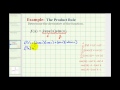
Understanding Derivatives and Trigonometric Identities

Interactive Video
•
Mathematics
•
9th - 12th Grade
•
Practice Problem
•
Hard

Aiden Montgomery
FREE Resource
Read more
10 questions
Show all answers
1.
MULTIPLE CHOICE QUESTION
30 sec • 1 pt
What is the first step in finding the derivative of a product of two functions?
Use the quotient rule
Apply the chain rule
Differentiate each function separately
Identify the functions involved
2.
MULTIPLE CHOICE QUESTION
30 sec • 1 pt
Which rule is used to find the derivative of a product of two functions?
Product rule
Power rule
Quotient rule
Chain rule
3.
MULTIPLE CHOICE QUESTION
30 sec • 1 pt
In the product rule, what is the derivative of f(x)g(x)?
f(x)g'(x) + g(x)f'(x)
f'(x)g(x) + f(x)g'(x)
f(x)g(x) + f'(x)g'(x)
f'(x)g'(x) + f(x)g(x)
4.
MULTIPLE CHOICE QUESTION
30 sec • 1 pt
What is the derivative of sine x?
negative sine x
sine x
cosine x
negative cosine x
5.
MULTIPLE CHOICE QUESTION
30 sec • 1 pt
What is the derivative of 2 cosine x?
2 cosine x
negative 2 cosine x
negative 2 sine x
2 sine x
6.
MULTIPLE CHOICE QUESTION
30 sec • 1 pt
What common factor can be factored out from the expression 2 cosine-squared x - 2 sine-squared x?
cosine x
sine x
2
1
7.
MULTIPLE CHOICE QUESTION
30 sec • 1 pt
What trigonometric identity is used to simplify the expression 2(cosine-squared x - sine-squared x)?
Pythagorean identity
Double angle identity
Sum-to-product identity
Angle addition identity
Access all questions and much more by creating a free account
Create resources
Host any resource
Get auto-graded reports

Continue with Google

Continue with Email

Continue with Classlink

Continue with Clever
or continue with

Microsoft
%20(1).png)
Apple

Others
Already have an account?

