
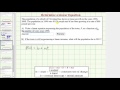
Linear Population Growth Analysis

Interactive Video
•
Mathematics
•
7th - 10th Grade
•
Practice Problem
•
Hard
+4
Standards-aligned

Emma Peterson
FREE Resource
Standards-aligned
Read more
10 questions
Show all answers
1.
MULTIPLE CHOICE QUESTION
30 sec • 1 pt
What type of growth did the population of the Cleveland suburb experience from 1996 to 2008?
Exponential
Logarithmic
Quadratic
Linear
Tags
CCSS.HSF.LE.B.5
2.
MULTIPLE CHOICE QUESTION
30 sec • 1 pt
In the linear function P(t) = b + mt, what does 'b' represent?
The year of prediction
The initial population
The rate of growth
The slope of the line
Tags
CCSS.8.EE.B.5
3.
MULTIPLE CHOICE QUESTION
30 sec • 1 pt
What is the slope 'm' in the linear equation for the population growth?
2013
1996
800
48,120
Tags
CCSS.HSF.LE.A.2
4.
MULTIPLE CHOICE QUESTION
30 sec • 1 pt
What is the initial population of the suburb in 1996?
61,720
800
48,120
17
Tags
CCSS.HSF-LE.A.1B
5.
MULTIPLE CHOICE QUESTION
30 sec • 1 pt
What is the constant rate of change in the population per year?
17
61,720
800
48,120
Tags
CCSS.HSF.IF.A.2
6.
MULTIPLE CHOICE QUESTION
30 sec • 1 pt
How do you calculate the number of years since 1996 for a given year?
Multiply the given year by 1996
Divide the given year by 1996
Subtract 1996 from the given year
Add 1996 to the given year
Tags
CCSS.HSF-LE.A.1C
7.
MULTIPLE CHOICE QUESTION
30 sec • 1 pt
Which year is used as the base year for calculating 't' in the function P(t)?
1996
2020
2008
2013
Tags
CCSS.HSF.IF.A.2
Access all questions and much more by creating a free account
Create resources
Host any resource
Get auto-graded reports

Continue with Google

Continue with Email

Continue with Classlink

Continue with Clever
or continue with

Microsoft
%20(1).png)
Apple

Others
Already have an account?

