
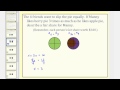
Fair Division Concepts and Principles

Interactive Video
•
Mathematics, Social Studies, Business
•
6th - 10th Grade
•
Practice Problem
•
Hard
+3
Standards-aligned

Jackson Turner
FREE Resource
Standards-aligned
Read more
10 questions
Show all answers
1.
MULTIPLE CHOICE QUESTION
30 sec • 1 pt
What is the primary goal of fair division?
To ensure each party receives an equal share
To minimize the number of items divided
To maximize the total value of the division
To ensure each party receives their fair share
2.
MULTIPLE CHOICE QUESTION
30 sec • 1 pt
Which of the following is NOT an assumption made in fair division methods?
Parties act rationally
Parties are non-cooperative
Parties have knowledge of others' valuations
No outside arbitrator is required
3.
MULTIPLE CHOICE QUESTION
30 sec • 1 pt
What does it mean for a division to be envy-free?
No party prefers another's share over their own
The division is completed quickly
Each party receives an equal portion
The division maximizes total value
Tags
CCSS.5.NF.B.3
4.
MULTIPLE CHOICE QUESTION
30 sec • 1 pt
What is a fair share when dividing something equally among N parties?
Half of the total value
N times the total value
Twice the total value
1/Nth of the total value
5.
MULTIPLE CHOICE QUESTION
30 sec • 1 pt
Why does fair division not need to be Pareto optimal?
Because it focuses on equal distribution
Because it ensures no one is worse off
Because it maximizes total value
Because it only needs to ensure each party's fair share
Tags
CCSS.8.EE.C.7B
6.
MULTIPLE CHOICE QUESTION
30 sec • 1 pt
In the example with Manny and the pies, what is Manny's valuation of the berry pie?
$12
$9
$6
$3
7.
MULTIPLE CHOICE QUESTION
30 sec • 1 pt
If Rita is allergic to berries, what is her fair share of the pies?
One piece of apple pie
One piece of berry pie
Two pieces of apple pie
Two pieces of berry pie
Tags
CCSS.6.NS.B.3
Access all questions and much more by creating a free account
Create resources
Host any resource
Get auto-graded reports

Continue with Google

Continue with Email

Continue with Classlink

Continue with Clever
or continue with

Microsoft
%20(1).png)
Apple

Others
Already have an account?


