
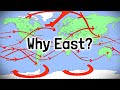
Understanding Solar Eclipses

Interactive Video
•
Physics, Science, Geography
•
9th - 12th Grade
•
Practice Problem
•
Hard

Lucas Foster
FREE Resource
Read more
10 questions
Show all answers
1.
MULTIPLE CHOICE QUESTION
30 sec • 1 pt
What is unusual about the movement of solar eclipses compared to the sun and moon?
They move from east to west.
They move from west to east.
They do not move at all.
They move in a circular path.
2.
MULTIPLE CHOICE QUESTION
30 sec • 1 pt
What determines the path of the moon through the sky?
The rotational speed of the Earth.
The position of the sun.
The line of sight from the Earth's surface.
The speed of the moon's shadow.
3.
MULTIPLE CHOICE QUESTION
30 sec • 1 pt
Why do eclipses appear to move from west to east?
The moon's shadow travels faster than the Earth's rotation.
The Earth's rotation is faster than the moon's orbit.
The sun's position changes rapidly.
The stars influence the eclipse path.
4.
MULTIPLE CHOICE QUESTION
30 sec • 1 pt
What is the speed of the moon's shadow as it travels across the Earth?
2000 miles per hour
4000 miles per hour
3000 miles per hour
1000 miles per hour
5.
MULTIPLE CHOICE QUESTION
30 sec • 1 pt
How long does it take for the moon's shadow to cross the Earth?
1 hour
6 hours
12 hours
3 and a half hours
6.
MULTIPLE CHOICE QUESTION
30 sec • 1 pt
What factor allows the moon to travel faster than the Earth's rotation?
The Earth's smaller size.
The moon's proximity to the Earth.
The moon's larger orbit.
The sun's gravitational pull.
7.
MULTIPLE CHOICE QUESTION
30 sec • 1 pt
What would happen if the Earth were twice as big?
Eclipses would move from east to west.
The direction of moonrise would change.
The moon would orbit faster.
The length of a day would change.
Access all questions and much more by creating a free account
Create resources
Host any resource
Get auto-graded reports

Continue with Google

Continue with Email

Continue with Microsoft
or continue with

%20(1).png)
Apple

Others
Already have an account?


