
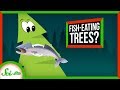
Nitrogen-15 and Tree Nutrient Dynamics

Interactive Video
•
Biology, Chemistry, Science
•
7th - 12th Grade
•
Practice Problem
•
Hard

Emma Peterson
FREE Resource
Read more
10 questions
Show all answers
1.
MULTIPLE CHOICE QUESTION
30 sec • 1 pt
What unique phenomenon occurs in forests on the west coast of North America?
Trees consume fish directly.
Trees obtain nutrients from salmon.
Trees have developed teeth.
Trees grow in the ocean.
2.
MULTIPLE CHOICE QUESTION
30 sec • 1 pt
How do trees primarily receive nutrients from salmon?
From bears leaving salmon scraps.
Via water absorption.
Through direct consumption.
By photosynthesis.
3.
MULTIPLE CHOICE QUESTION
30 sec • 1 pt
What is often the limiting nutrient for trees on the northwest coast of North America?
Calcium
Potassium
Nitrogen
Phosphorus
4.
MULTIPLE CHOICE QUESTION
30 sec • 1 pt
What makes nitrogen-15 different from nitrogen-14?
It is unstable.
It has more neutrons.
It has fewer neutrons.
It is more abundant on land.
5.
MULTIPLE CHOICE QUESTION
30 sec • 1 pt
Why do salmon have a higher amount of nitrogen-15 compared to land animals?
They live in freshwater.
They are at the bottom of the food chain.
They spend most of their life in the ocean.
They consume more plants.
6.
MULTIPLE CHOICE QUESTION
30 sec • 1 pt
What did researchers discover about trees near salmon streams in Alaska?
They grow slower than other trees.
They have high levels of nitrogen-15.
They do not benefit from salmon.
They have low levels of nitrogen-15.
7.
MULTIPLE CHOICE QUESTION
30 sec • 1 pt
How do tree rings help in understanding the importance of salmon to trees?
They display the tree's height.
They show the color of the tree.
They reveal nitrogen levels over the years.
They indicate the age of the tree.
Access all questions and much more by creating a free account
Create resources
Host any resource
Get auto-graded reports

Continue with Google

Continue with Email

Continue with Classlink

Continue with Clever
or continue with

Microsoft
%20(1).png)
Apple

Others
Already have an account?

