
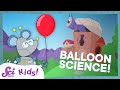
Balloon Science Experiments and Concepts

Interactive Video
•
Science, Chemistry, Physics
•
2nd - 5th Grade
•
Practice Problem
•
Medium

Lucas Foster
Used 6+ times
FREE Resource
Read more
10 questions
Show all answers
1.
MULTIPLE CHOICE QUESTION
30 sec • 1 pt
What are the two kitchen ingredients used to inflate a balloon in the experiment?
Baking soda and vinegar
Salt and water
Sugar and lemon juice
Flour and oil
2.
MULTIPLE CHOICE QUESTION
30 sec • 1 pt
What is the product formed when baking soda and vinegar react?
A solid and a liquid
A liquid and a gas
A solid and a gas
Only a gas
3.
MULTIPLE CHOICE QUESTION
30 sec • 1 pt
What causes a balloon to move when air is released from it?
Gravity
Electricity
Magnetism
Force from escaping air
4.
MULTIPLE CHOICE QUESTION
30 sec • 1 pt
What materials are needed to create a balloon rocket?
String, straw, tape, and a balloon
Paper, glue, scissors, and a balloon
Plastic, rubber band, and a balloon
Wood, nails, hammer, and a balloon
5.
MULTIPLE CHOICE QUESTION
30 sec • 1 pt
What is the scientific principle behind a balloon sticking to a wall after being rubbed on a shirt?
Static electricity
Friction
Magnetism
Gravity
6.
MULTIPLE CHOICE QUESTION
30 sec • 1 pt
What happens to the particles on a balloon when it is rubbed on a shirt?
The particles remain unchanged
The balloon gains negative particles
The balloon gains positive particles
The balloon loses particles
7.
MULTIPLE CHOICE QUESTION
30 sec • 1 pt
Why do helium balloons rise into the sky?
They are pushed by the wind
They are attracted by the sun
They are lighter than air
They are heavier than air
Access all questions and much more by creating a free account
Create resources
Host any resource
Get auto-graded reports

Continue with Google

Continue with Email

Continue with Classlink

Continue with Clever
or continue with

Microsoft
%20(1).png)
Apple

Others
Already have an account?
Popular Resources on Wayground

15 questions
Fractions on a Number Line

Quiz
•
3rd Grade
20 questions
Equivalent Fractions
Quiz
•
3rd Grade
25 questions
Multiplication Facts
Quiz
•
5th Grade
29 questions
Alg. 1 Section 5.1 Coordinate Plane
Quiz
•
9th Grade
22 questions
fractions
Quiz
•
3rd Grade
11 questions
FOREST Effective communication

Lesson
•
KG
20 questions
Main Idea and Details
Quiz
•
5th Grade
20 questions
Context Clues
Quiz
•
6th Grade
Discover more resources for Science
12 questions
Structures and Functions
Quiz
•
3rd - 5th Grade
20 questions
Weathering, Erosion, Deposition
Quiz
•
5th Grade
22 questions
Ancient Greece
Quiz
•
3rd Grade
15 questions
Physical and Chemical Changes
Quiz
•
4th Grade
10 questions
Plants Respond to Stimuli
Quiz
•
3rd Grade
20 questions
Food Chains and Food Webs Review
Quiz
•
5th Grade
17 questions
5.9B Food Chain & Food Web 2.0
Quiz
•
5th Grade
10 questions
Sedimentary rocks
Quiz
•
5th Grade