
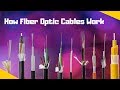
Understanding Total Internal Reflection and Fiber Optic Cables

Interactive Video
•
Physics, Science
•
5th - 8th Grade
•
Practice Problem
•
Hard

Emma Peterson
FREE Resource
Read more
9 questions
Show all answers
1.
MULTIPLE CHOICE QUESTION
30 sec • 1 pt
What is the main principle that allows fiber optic cables to function effectively?
Dispersion of light
Refraction of light
Total internal reflection
Diffraction of light
2.
MULTIPLE CHOICE QUESTION
30 sec • 1 pt
Which of the following is NOT a common use of fiber optic cables?
Internet cables
Telephone lines
Cable television
Solar panels
3.
MULTIPLE CHOICE QUESTION
30 sec • 1 pt
In the first demonstration, what is used to show total internal reflection?
A metal rod
A mirror
A plastic bottle with water
A glass prism
4.
MULTIPLE CHOICE QUESTION
30 sec • 1 pt
What happens to the laser beam when it is shone on the water in the first demonstration?
It stays inside the stream of water
It disperses into a spectrum
It gets absorbed by the water
It refracts out of the water
5.
MULTIPLE CHOICE QUESTION
30 sec • 1 pt
What additional material is used in the second demonstration to illustrate total internal reflection?
Salt
Sand
Milk
Oil
6.
MULTIPLE CHOICE QUESTION
30 sec • 1 pt
How does the milk in the second demonstration affect the laser light?
It disperses the light
It reflects the light inward
It refracts the light
It absorbs the light
7.
MULTIPLE CHOICE QUESTION
30 sec • 1 pt
What is the key takeaway from the demonstrations regarding fiber optic cables?
They work best in sunlight
They are made of metal
They rely on total internal reflection to transmit data
They use mirrors to reflect light
Access all questions and much more by creating a free account
Create resources
Host any resource
Get auto-graded reports

Continue with Google

Continue with Email

Continue with Classlink

Continue with Clever
or continue with

Microsoft
%20(1).png)
Apple

Others
Already have an account?

