
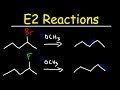
E2 Reactions and Stability Concepts

Interactive Video
•
Chemistry, Science
•
10th Grade - University
•
Practice Problem
•
Hard

Sophia Harris
FREE Resource
Read more
10 questions
Show all answers
1.
MULTIPLE CHOICE QUESTION
30 sec • 1 pt
What is the order of the E2 reaction with respect to the substrate and base?
First order with respect to base only
First order with respect to substrate only
Second order with respect to both
First order with respect to both
2.
MULTIPLE CHOICE QUESTION
30 sec • 1 pt
Which product is more stable in an E2 reaction, Zaitsev or Hofmann?
Hofmann product
Zaitsev product
Both are equally stable
Neither is stable
3.
MULTIPLE CHOICE QUESTION
30 sec • 1 pt
Why do bulky bases prefer to form Hofmann products?
They are less reactive
Due to electronic effects
They are more reactive
Due to steric hindrance
4.
MULTIPLE CHOICE QUESTION
30 sec • 1 pt
What is the major product when using a bulky base like terpetoxide?
Hofmann product
Zaitsev product
No reaction occurs
Both products equally
5.
MULTIPLE CHOICE QUESTION
30 sec • 1 pt
Why do alkyl fluorides tend to form Hofmann products?
Fluorine is a good leaving group
Fluorine stabilizes the transition state
Fluorine destabilizes the transition state
Fluorine is a poor leaving group
6.
MULTIPLE CHOICE QUESTION
30 sec • 1 pt
Which leaving group quality favors the formation of Zaitsev products?
No leaving group
Poor leaving group
Good leaving group
Neutral leaving group
7.
MULTIPLE CHOICE QUESTION
30 sec • 1 pt
What is the effect of a good leaving group on the transition state?
No effect on transition state
Resembles a carbocation
Resembles an alkene
Resembles a carbanion
Access all questions and much more by creating a free account
Create resources
Host any resource
Get auto-graded reports

Continue with Google

Continue with Email

Continue with Classlink

Continue with Clever
or continue with

Microsoft
%20(1).png)
Apple

Others
Already have an account?

