
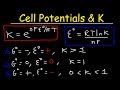
Cell Potential and Gibbs Free Energy

Interactive Video
•
Chemistry, Science
•
10th - 12th Grade
•
Practice Problem
•
Hard

Olivia Brooks
FREE Resource
Read more
10 questions
Show all answers
1.
MULTIPLE CHOICE QUESTION
30 sec • 1 pt
What is the purpose of adjusting half-reactions in a galvanic cell?
To ensure the total cell potential is positive
To ensure the electrons are on the same side
To increase the number of electrons involved
To make the total cell potential negative
2.
MULTIPLE CHOICE QUESTION
30 sec • 1 pt
Which formula relates Gibbs free energy to the equilibrium constant?
K = e^(nFE/RT)
E = RT ln K / nF
ΔG = -RT ln K
ΔG = nFE
3.
MULTIPLE CHOICE QUESTION
30 sec • 1 pt
What is the value of Faraday's constant used in these calculations?
8.3145 J/mol·K
96,485 C/mol
0.93 V
298 K
4.
MULTIPLE CHOICE QUESTION
30 sec • 1 pt
How can you calculate the cell potential if you know the equilibrium constant?
Using ΔG = nFE
Using ΔG = -RT ln K
Using K = e^(nFE/RT)
Using E = RT ln K / nF
5.
MULTIPLE CHOICE QUESTION
30 sec • 1 pt
What happens to the cell potential when a reaction is reversed?
It becomes negative if it was positive
It becomes positive if it was negative
It remains unchanged
It becomes zero
6.
MULTIPLE CHOICE QUESTION
30 sec • 1 pt
What is the cell potential for a reaction if the combined potentials of two reactions are 0.467 V and 0.23 V?
0.237 V
0.697 V
0.467 V
0.23 V
7.
MULTIPLE CHOICE QUESTION
30 sec • 1 pt
In a spontaneous reaction, what is the sign of the cell potential?
Positive
Undefined
Zero
Negative
Access all questions and much more by creating a free account
Create resources
Host any resource
Get auto-graded reports

Continue with Google

Continue with Email

Continue with Microsoft
or continue with

%20(1).png)
Apple

Others
By signing up, you agree to our Terms of Service & Privacy Policy
Already have an account?


