
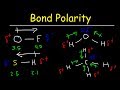
Understanding Bond Polarity and Dipole Moments

Interactive Video
•
Chemistry, Science
•
9th - 12th Grade
•
Practice Problem
•
Easy

Mia Campbell
Used 15+ times
FREE Resource
Read more
10 questions
Show all answers
1.
MULTIPLE CHOICE QUESTION
30 sec • 1 pt
What is the electronegativity difference required for a bond to be considered polar?
Greater than 1.0
Exactly 0.5
Less than 0.5
Greater than 0.5
2.
MULTIPLE CHOICE QUESTION
30 sec • 1 pt
What is the bond polarity of the carbon-oxygen bond?
Polar
Nonpolar
Ionic
Metallic
3.
MULTIPLE CHOICE QUESTION
30 sec • 1 pt
In a polar covalent bond, which atom acquires a partial negative charge?
The atom with higher electronegativity
The atom with no electronegativity
The atom with equal electronegativity
The atom with lower electronegativity
4.
MULTIPLE CHOICE QUESTION
30 sec • 1 pt
Which element in the oxygen-fluorine bond is more electronegative?
Neither is electronegative
Both are equally electronegative
Fluorine
Oxygen
5.
MULTIPLE CHOICE QUESTION
30 sec • 1 pt
What is the electronegativity difference between sulfur and hydrogen?
0.6
0.8
0.4
0.2
6.
MULTIPLE CHOICE QUESTION
30 sec • 1 pt
What type of bond is formed between sulfur and hydrogen?
Polar covalent bond
Metallic bond
Nonpolar covalent bond
Ionic bond
7.
MULTIPLE CHOICE QUESTION
30 sec • 1 pt
In the water molecule, which component of the dipole moment does not cancel out?
X component
None of the components
Y component
Z component
Access all questions and much more by creating a free account
Create resources
Host any resource
Get auto-graded reports

Continue with Google

Continue with Email

Continue with Classlink

Continue with Clever
or continue with

Microsoft
%20(1).png)
Apple

Others
Already have an account?

