
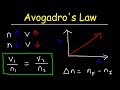
Understanding Avogadro's Law

Interactive Video
•
Physics, Chemistry, Science
•
9th - 12th Grade
•
Practice Problem
•
Hard

Mia Campbell
FREE Resource
Read more
10 questions
Show all answers
1.
MULTIPLE CHOICE QUESTION
30 sec • 1 pt
What happens to the volume of a balloon when more moles of gas are added?
The volume fluctuates randomly.
The volume increases.
The volume remains the same.
The volume decreases.
2.
MULTIPLE CHOICE QUESTION
30 sec • 1 pt
How many particles are there in one mole?
12
1 x 10^6
6 x 10^23
3.14
3.
MULTIPLE CHOICE QUESTION
30 sec • 1 pt
What is the formula associated with Avogadro's Law?
F = ma
PV = nRT
V1/N1 = V2/N2
P1/T1 = P2/T2
4.
MULTIPLE CHOICE QUESTION
30 sec • 1 pt
In the formula V1/N1 = V2/N2, what must be true about the units of V1 and V2?
They must be in the same units.
They must be in milliliters.
They must be in liters.
They must be in different units.
5.
MULTIPLE CHOICE QUESTION
30 sec • 1 pt
If 2.4 moles of gas occupy 60 liters, what volume will 3.7 moles occupy?
92.5 liters
60 liters
44.8 liters
120 liters
6.
MULTIPLE CHOICE QUESTION
30 sec • 1 pt
What is the new volume of a balloon if 0.45 moles of gas are added to 0.35 moles in a 250 ml balloon?
500 ml
571.4 ml
800 ml
250 ml
7.
MULTIPLE CHOICE QUESTION
30 sec • 1 pt
What is the relationship between moles and volume according to Avogadro's Law?
Inverse relationship
Direct relationship
Exponential relationship
No relationship
Access all questions and much more by creating a free account
Create resources
Host any resource
Get auto-graded reports

Continue with Google

Continue with Email

Continue with Classlink

Continue with Clever
or continue with

Microsoft
%20(1).png)
Apple

Others
Already have an account?


