
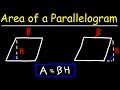
Understanding the Area of a Parallelogram

Interactive Video
•
Mathematics
•
5th - 8th Grade
•
Practice Problem
•
Hard
Standards-aligned

Lucas Foster
FREE Resource
Standards-aligned
Read more
10 questions
Show all answers
1.
MULTIPLE CHOICE QUESTION
30 sec • 1 pt
What two measurements are needed to calculate the area of a parallelogram?
Perimeter and height
Diagonal and side
Base and height
Length and width
Tags
CCSS.6.G.A.1
2.
MULTIPLE CHOICE QUESTION
30 sec • 1 pt
If a parallelogram has a base of 30 and a height of 15, what is its area?
400 square units
500 square units
300 square units
450 square units
Tags
CCSS.6.G.A.1
3.
MULTIPLE CHOICE QUESTION
30 sec • 1 pt
What is the formula used to find the area of a parallelogram?
Base divided by height
Base times height
Base plus height
Base minus height
Tags
CCSS.6.G.A.1
4.
MULTIPLE CHOICE QUESTION
30 sec • 1 pt
For a parallelogram with a base of 20 and a height of 25, what is the area?
400 square units
450 square units
500 square units
550 square units
Tags
CCSS.6.G.A.1
5.
MULTIPLE CHOICE QUESTION
30 sec • 1 pt
What is the first step in finding the height of a parallelogram when given sides of 11, 13, and 6?
Subtract the smaller side from the larger side
Add all sides together
Use the Pythagorean theorem
Divide the base by the height
Tags
CCSS.8.G.B.8
6.
MULTIPLE CHOICE QUESTION
30 sec • 1 pt
In the context of the Pythagorean theorem, what does 'c' represent?
The base
The height
The hypotenuse
The area
Tags
CCSS.8.G.B.8
7.
MULTIPLE CHOICE QUESTION
30 sec • 1 pt
What is the value of the missing side when using the Pythagorean theorem with sides 5 and 13?
12
11
10
13
Tags
CCSS.6.G.A.1
Access all questions and much more by creating a free account
Create resources
Host any resource
Get auto-graded reports

Continue with Google

Continue with Email

Continue with Microsoft
or continue with

%20(1).png)
Apple

Others
By signing up, you agree to our Terms of Service & Privacy Policy
Already have an account?

