
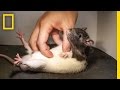
Understanding Ticklishness in Rats

Interactive Video
•
Biology, Science
•
7th - 12th Grade
•
Practice Problem
•
Hard

Jackson Turner
FREE Resource
Read more
10 questions
Show all answers
1.
MULTIPLE CHOICE QUESTION
30 sec • 1 pt
What was the main focus of the research conducted by scientists at Humboldt University of Berlin?
The brain's response to tickling
The effect of music on rats
The migration patterns of rats
The diet of young rats
2.
MULTIPLE CHOICE QUESTION
30 sec • 1 pt
What is the typical hearing range of humans?
40 Hertz to 40 kilohertz
30 Hertz to 30 kilohertz
20 Hertz to 20 kilohertz
10 Hertz to 10 kilohertz
3.
MULTIPLE CHOICE QUESTION
30 sec • 1 pt
At what frequency do rats vocalize when they are happy?
30 kilohertz
22 kilohertz
70 kilohertz
50 kilohertz
4.
MULTIPLE CHOICE QUESTION
30 sec • 1 pt
How do rats react when the tickling stops?
They fall asleep
They become aggressive
They look for the hand
They run away
5.
MULTIPLE CHOICE QUESTION
30 sec • 1 pt
What is the role of the somatosensory cortex in rats?
It processes ticklishness
It manages their vocalizations
It regulates sleep
It controls their diet
6.
MULTIPLE CHOICE QUESTION
30 sec • 1 pt
Which part of a rat's body is the most ticklish?
Tail
Paws
Ears
Trunk
7.
MULTIPLE CHOICE QUESTION
30 sec • 1 pt
What did researchers use to test if ticklishness can be induced without physical contact?
Sound waves
Chemical sprays
Electrical stimulation
Light pulses
Access all questions and much more by creating a free account
Create resources
Host any resource
Get auto-graded reports

Continue with Google

Continue with Email

Continue with Classlink

Continue with Clever
or continue with

Microsoft
%20(1).png)
Apple

Others
Already have an account?

