
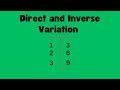
Understanding Direct and Inverse Variation

Interactive Video
•
Mathematics
•
6th - 8th Grade
•
Practice Problem
•
Hard
Standards-aligned

Liam Anderson
FREE Resource
Standards-aligned
Read more
10 questions
Show all answers
1.
MULTIPLE CHOICE QUESTION
30 sec • 1 pt
What is the main focus of the video tutorial?
Exploring geometric shapes
Learning about linear equations
Understanding direct and inverse variation
Solving quadratic equations
2.
MULTIPLE CHOICE QUESTION
30 sec • 1 pt
In a direct variation, what happens to Y as X increases?
Y decreases
Y remains constant
Y becomes zero
Y increases
Tags
CCSS.HSF-LE.A.1B
3.
MULTIPLE CHOICE QUESTION
30 sec • 1 pt
Which of the following is true for inverse variation?
Both X and Y increase
X increases while Y decreases
Both X and Y decrease
X decreases while Y increases
4.
MULTIPLE CHOICE QUESTION
30 sec • 1 pt
What is the constant of variation (K) in a direct variation if Y = 3X?
1
2
3
4
Tags
CCSS.HSF-LE.A.1B
5.
MULTIPLE CHOICE QUESTION
30 sec • 1 pt
If X is 5 in a direct variation where Y = 3X, what is Y?
15
25
10
20
6.
MULTIPLE CHOICE QUESTION
30 sec • 1 pt
What pattern is observed in a direct variation?
Addition
Subtraction
Multiplication
Division
7.
MULTIPLE CHOICE QUESTION
30 sec • 1 pt
What is the equation form for a direct variation?
Y = X - K
Y = K/X
Y = K + X
Y = KX
Access all questions and much more by creating a free account
Create resources
Host any resource
Get auto-graded reports

Continue with Google

Continue with Email

Continue with Microsoft
or continue with

%20(1).png)
Apple

Others
By signing up, you agree to our Terms of Service & Privacy Policy
Already have an account?

