
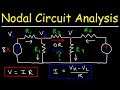
Circuit Analysis and Current Flow

Interactive Video
•
Physics, Science
•
10th - 12th Grade
•
Practice Problem
•
Hard

Lucas Foster
FREE Resource
Read more
10 questions
Show all answers
1.
MULTIPLE CHOICE QUESTION
30 sec • 1 pt
What is the initial voltage of the source in the circuit described in the video?
60 volts
50 volts
70 volts
80 volts
2.
MULTIPLE CHOICE QUESTION
30 sec • 1 pt
According to Kirchhoff's Current Law, what should the sum of currents at a junction equal?
Zero
The voltage at the junction
The resistance at the junction
The power at the junction
3.
MULTIPLE CHOICE QUESTION
30 sec • 1 pt
How is the current through a resistor calculated using Ohm's Law?
Current divided by resistance
Voltage times resistance
Voltage divided by resistance
Current times resistance
4.
MULTIPLE CHOICE QUESTION
30 sec • 1 pt
What is the electric potential at point A after solving the circuit?
30 volts
40 volts
50 volts
60 volts
5.
MULTIPLE CHOICE QUESTION
30 sec • 1 pt
In the new circuit example, what is the value of the independent current source?
8 amps
5 amps
7 amps
6 amps
6.
MULTIPLE CHOICE QUESTION
30 sec • 1 pt
What is the resistance of R4 in the new circuit example?
3 ohms
4 ohms
5 ohms
6 ohms
7.
MULTIPLE CHOICE QUESTION
30 sec • 1 pt
How do you determine the direction of current flow between two nodes?
By measuring the current directly
By comparing the electric potentials
By comparing the resistances
By guessing
Access all questions and much more by creating a free account
Create resources
Host any resource
Get auto-graded reports

Continue with Google

Continue with Email

Continue with Classlink

Continue with Clever
or continue with

Microsoft
%20(1).png)
Apple

Others
Already have an account?
Similar Resources on Wayground

6 questions
Chemistry professor Mircea Dincă discusses Alan T. Waterman Award
Interactive video
•
11th Grade - University
6 questions
¿Por qué la Tierra tiene desiertos?
Interactive video
•
11th Grade - University
11 questions
Exploring Series and Parallel Circuits
Interactive video
•
9th - 12th Grade
8 questions
Why Does Venus Spin Backwards?
Interactive video
•
11th Grade - University
8 questions
Treating Blindness With Light (and Gene Therapy) | SciShow News
Interactive video
•
11th Grade - University
8 questions
The Only Radiation Units You Need to Know
Interactive video
•
11th Grade - University
8 questions
Silicon - The Internet's Favorite Element: Crash Course Chemistry
Interactive video
•
11th Grade - University
11 questions
Muscle Contraction Mechanisms and Structures
Interactive video
•
9th - 12th Grade
Popular Resources on Wayground
15 questions
Fractions on a Number Line

Quiz
•
3rd Grade
10 questions
Probability Practice
Quiz
•
4th Grade
15 questions
Probability on Number LIne
Quiz
•
4th Grade
20 questions
Equivalent Fractions
Quiz
•
3rd Grade
25 questions
Multiplication Facts
Quiz
•
5th Grade
22 questions
fractions
Quiz
•
3rd Grade
6 questions
Appropriate Chromebook Usage

Lesson
•
7th Grade
10 questions
Greek Bases tele and phon
Quiz
•
6th - 8th Grade
Discover more resources for Physics
22 questions
Waves
Quiz
•
KG - University
10 questions
Exploring the Properties of Waves
Interactive video
•
9th - 12th Grade
14 questions
Bill Nye Waves
Interactive video
•
9th - 12th Grade
18 questions
Work, Energy and Power MC Review
Quiz
•
11th Grade
20 questions
Conservation of Momentum
Quiz
•
11th Grade