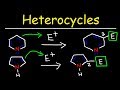
Electrophilic and Nucleophilic Aromatic Substitution

Interactive Video
•
Chemistry, Science
•
10th Grade - University
•
Practice Problem
•
Hard

Amelia Wright
FREE Resource
Read more
10 questions
Show all answers
1.
MULTIPLE CHOICE QUESTION
30 sec • 1 pt
Why does bromination of pyrrole not require a Lewis acid catalyst?
Pyrrole is less reactive than benzene.
Pyrrole is not an aromatic compound.
Pyrrole is more nucleophilic than benzene.
Bromine is a weak electrophile.
2.
MULTIPLE CHOICE QUESTION
30 sec • 1 pt
Which position does bromine prefer to substitute in pyrrole?
Position 4
Position 3
Position 2
Position 1
3.
MULTIPLE CHOICE QUESTION
30 sec • 1 pt
Which of the following is more nucleophilic than benzene?
Furan
All of the above
Thiophene
Pyrrole
4.
MULTIPLE CHOICE QUESTION
30 sec • 1 pt
Why is thiophene less nucleophilic than furan?
Furan has a larger ring size.
Thiophene is not aromatic.
Sulfur's 3p orbital does not overlap effectively with carbon's 2p orbital.
Sulfur is more electronegative than oxygen.
5.
MULTIPLE CHOICE QUESTION
30 sec • 1 pt
Why does electrophilic attack prefer the two position in pyrrole?
It allows for more resonance structures.
It is less sterically hindered.
It is closer to the nitrogen atom.
It is more electronegative.
6.
MULTIPLE CHOICE QUESTION
30 sec • 1 pt
In pyridine, which position is favored for electrophilic substitution?
Position 2
Position 3
Position 1
Position 4
7.
MULTIPLE CHOICE QUESTION
30 sec • 1 pt
Why is pyridine less reactive than benzene in electrophilic aromatic substitution?
Pyridine is not aromatic.
Pyridine has a nitrogen atom that deactivates the ring.
Pyridine is more nucleophilic.
Pyridine has a larger ring size.
Access all questions and much more by creating a free account
Create resources
Host any resource
Get auto-graded reports

Continue with Google

Continue with Email

Continue with Classlink

Continue with Clever
or continue with

Microsoft
%20(1).png)
Apple

Others
Already have an account?
Similar Resources on Wayground

11 questions
Determining SN1, SN2, E1, and E2 Reactions: Crash Course Organic Chemistry
Interactive video
•
11th Grade - University
6 questions
American English slang: Hand me that please!
Interactive video
•
KG - University
8 questions
Write the Equation of a Circle Given Parts Easy Medium Hard
Interactive video
•
11th Grade - University
8 questions
How to use the law of sines to find the missing parts of a triangle
Interactive video
•
11th Grade - University
8 questions
Carbenes Part 2: Cyclopropanation, C-H Insertion, and the Bamford-Stevens Reaction
Interactive video
•
11th Grade - University
8 questions
Aromatics and Cyclic Compounds - Crash Course Chemistry
Interactive video
•
11th Grade - University
11 questions
Improper Integrals and Exponential Functions
Interactive video
•
11th Grade - University
Popular Resources on Wayground
15 questions
Fractions on a Number Line

Quiz
•
3rd Grade
20 questions
Equivalent Fractions
Quiz
•
3rd Grade
25 questions
Multiplication Facts
Quiz
•
5th Grade
22 questions
fractions
Quiz
•
3rd Grade
20 questions
Main Idea and Details
Quiz
•
5th Grade
20 questions
Context Clues
Quiz
•
6th Grade
15 questions
Equivalent Fractions
Quiz
•
4th Grade
20 questions
Figurative Language Review
Quiz
•
6th Grade
Discover more resources for Chemistry
20 questions
Types of Chemical Reactions
Quiz
•
9th - 12th Grade
20 questions
Energy Transformations
Quiz
•
9th - 12th Grade
20 questions
Periodic Table & Trends
Quiz
•
10th Grade
17 questions
Reaction Rates
Quiz
•
11th Grade
20 questions
Periodic Trends
Quiz
•
10th Grade
24 questions
Identifying Types of Chemical Reactions
Quiz
•
10th - 12th Grade
20 questions
Naming & Writing Chemical Formulas
Quiz
•
10th Grade
20 questions
Atomic Structure
Quiz
•
10th - 12th Grade