
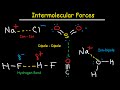
Intermolecular Forces and Properties

Interactive Video
•
Chemistry, Science
•
10th - 12th Grade
•
Practice Problem
•
Easy

Aiden Montgomery
Used 1+ times
FREE Resource
Read more
10 questions
Show all answers
1.
MULTIPLE CHOICE QUESTION
30 sec • 1 pt
Which factor increases the strength of ion-ion interactions?
Decreasing the size of ions
Increasing the charge of ions
Increasing the distance between ions
Decreasing the charge of ions
2.
MULTIPLE CHOICE QUESTION
30 sec • 1 pt
What type of interaction occurs between a sodium ion and water?
Hydrogen bond
Ion-dipole interaction
Dipole-dipole interaction
Ion-ion interaction
3.
MULTIPLE CHOICE QUESTION
30 sec • 1 pt
Which of the following is a characteristic of hydrogen bonds?
They involve hydrogen and highly electronegative atoms like N, O, or F.
They are weaker than London dispersion forces.
They occur between non-polar molecules.
They are a type of ion-ion interaction.
4.
MULTIPLE CHOICE QUESTION
30 sec • 1 pt
What is the primary force present in non-polar molecules?
London dispersion forces
Hydrogen bonds
Dipole-dipole interactions
Ion-ion interactions
5.
MULTIPLE CHOICE QUESTION
30 sec • 1 pt
Which intermolecular force is the weakest?
London dispersion force
Hydrogen bond
Dipole-dipole interaction
Ion-ion interaction
6.
MULTIPLE CHOICE QUESTION
30 sec • 1 pt
What type of intermolecular force is predominant in methane (CH4)?
London dispersion force
Hydrogen bond
Dipole-dipole interaction
Ion-ion interaction
7.
MULTIPLE CHOICE QUESTION
30 sec • 1 pt
Which compound is likely to have a higher boiling point, CH3OH or CH4?
CH4, because it is non-polar
CH3OH, because it is non-polar
CH3OH, because it has hydrogen bonds
CH4, because it has more electrons
Access all questions and much more by creating a free account
Create resources
Host any resource
Get auto-graded reports

Continue with Google

Continue with Email

Continue with Classlink

Continue with Clever
or continue with

Microsoft
%20(1).png)
Apple

Others
Already have an account?
Similar Resources on Wayground

11 questions
Balancing Redox Reactions Concepts
Interactive video
•
9th - 12th Grade
8 questions
Water: A Polar Molecule
Interactive video
•
11th Grade - University
11 questions
L7.2 Tectonic Plate Movement Mechanisms
Interactive video
•
9th - 12th Grade
11 questions
Understanding Atomic Structure and Antimatter
Interactive video
•
9th - 12th Grade
6 questions
Anchor Bolts and Alternatives
Interactive video
•
10th - 12th Grade
11 questions
Stanley Miller's Experiment and the Origin of Life
Interactive video
•
10th - 12th Grade
Popular Resources on Wayground
15 questions
Fractions on a Number Line

Quiz
•
3rd Grade
10 questions
Probability Practice
Quiz
•
4th Grade
15 questions
Probability on Number LIne
Quiz
•
4th Grade
20 questions
Equivalent Fractions
Quiz
•
3rd Grade
25 questions
Multiplication Facts
Quiz
•
5th Grade
22 questions
fractions
Quiz
•
3rd Grade
6 questions
Appropriate Chromebook Usage

Lesson
•
7th Grade
10 questions
Greek Bases tele and phon
Quiz
•
6th - 8th Grade
Discover more resources for Chemistry
20 questions
Predicting Products
Quiz
•
9th - 12th Grade
10 questions
Exploring Types of Chemical Reactions
Interactive video
•
6th - 10th Grade
19 questions
Stoichiometry, % yield, Limiting Reactants
Quiz
•
10th Grade
20 questions
Types of Chemical Reactions
Quiz
•
9th - 12th Grade
10 questions
Exploring Ionic and Covalent Bonding Concepts
Interactive video
•
6th - 10th Grade
7 questions
GCSE Chemistry - Balancing Chemical Equations #4
Interactive video
•
9th - 10th Grade
24 questions
Unit 2 (Part 1) Bonding Review
Quiz
•
12th Grade
12 questions
Percent Yield
Quiz
•
10th Grade