
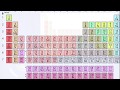
Understanding Actinides and Their Properties

Interactive Video
•
Science, Physics, Chemistry
•
9th - 12th Grade
•
Practice Problem
•
Hard

Lucas Foster
FREE Resource
Read more
8 questions
Show all answers
1.
MULTIPLE CHOICE QUESTION
30 sec • 1 pt
Why are periods six and seven sometimes shown in two rows at the bottom of the periodic table?
To make the table more colorful
To separate metals from nonmetals
To highlight important elements
To keep the table from being too wide
2.
MULTIPLE CHOICE QUESTION
30 sec • 1 pt
What is the F block in the periodic table?
A collection of alkali metals
A block of elements where electrons are added to the F orbitals
A series of noble gases
A group of nonmetals
3.
MULTIPLE CHOICE QUESTION
30 sec • 1 pt
Which elements are included in the actinide series?
Elements 104 through 118
Elements 1 through 18
Elements 89 through 103
Elements 57 through 71
4.
MULTIPLE CHOICE QUESTION
30 sec • 1 pt
What is a common property of all actinide elements?
They are all liquids at room temperature
They are all radioactive or unstable
They are all non-radioactive
They are all gases at room temperature
5.
MULTIPLE CHOICE QUESTION
30 sec • 1 pt
How do actinides typically react with air?
They tarnish easily
They do not react with air
They become gaseous
They explode on contact
6.
MULTIPLE CHOICE QUESTION
30 sec • 1 pt
Which of the following is a characteristic of actinides?
They are very light metals
They are poor conductors of electricity
They are very dense metals
They are non-reactive with nonmetals
7.
MULTIPLE CHOICE QUESTION
30 sec • 1 pt
What are uranium and plutonium primarily used for?
Building construction
Manufacturing electronics
Producing energy and powerful bombs
Creating jewelry
Access all questions and much more by creating a free account
Create resources
Host any resource
Get auto-graded reports

Continue with Google

Continue with Email

Continue with Microsoft
or continue with

%20(1).png)
Apple

Others
Already have an account?

