
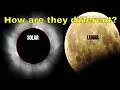
Understanding Solar and Lunar Eclipses

Interactive Video
•
Science, Physics
•
5th - 8th Grade
•
Practice Problem
•
Hard

Lucas Foster
FREE Resource
Read more
7 questions
Show all answers
1.
MULTIPLE CHOICE QUESTION
30 sec • 1 pt
What is an eclipse?
When the Earth rotates
When the Moon is full
When the Sun disappears
When the shadow of one celestial body falls on another
2.
MULTIPLE CHOICE QUESTION
30 sec • 1 pt
During a solar eclipse, which celestial body comes between the other two?
Sun
Earth
Mars
Moon
3.
MULTIPLE CHOICE QUESTION
30 sec • 1 pt
Why should you never look directly at the Sun during a solar eclipse?
It can damage your eyes
It is not visible
It is too far away
It is too bright
4.
MULTIPLE CHOICE QUESTION
30 sec • 1 pt
In a lunar eclipse, what is the order of the celestial bodies?
Earth, Sun, Moon
Moon, Sun, Earth
Sun, Earth, Moon
Sun, Moon, Earth
5.
MULTIPLE CHOICE QUESTION
30 sec • 1 pt
Why don't we see a solar and lunar eclipse every month?
The Moon is too small
The Moon's orbit is tilted
The Sun is too far
The Earth rotates too fast
6.
MULTIPLE CHOICE QUESTION
30 sec • 1 pt
What is the main difference between a solar and a lunar eclipse?
The time of day they occur
The celestial body casting the shadow
The color of the sky
The duration of the eclipse
7.
MULTIPLE CHOICE QUESTION
30 sec • 1 pt
What is the reason for the infrequency of eclipses?
The size of the Sun
The tilt of the Moon's orbit
The Earth's rotation speed
The distance between Earth and Moon
Access all questions and much more by creating a free account
Create resources
Host any resource
Get auto-graded reports

Continue with Google

Continue with Email

Continue with Classlink

Continue with Clever
or continue with

Microsoft
%20(1).png)
Apple

Others
Already have an account?


