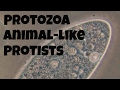
Protozoans: Characteristics and Classification

Interactive Video
•
Biology, Science
•
5th - 8th Grade
•
Practice Problem
•
Hard

Ethan Morris
FREE Resource
Read more
8 questions
Show all answers
1.
MULTIPLE CHOICE QUESTION
30 sec • 1 pt
What are protozoa classified as within the Kingdom Protista?
Plant-like protists
Bacteria-like protists
Animal-like protists
Fungus-like protists
2.
MULTIPLE CHOICE QUESTION
30 sec • 1 pt
Which of the following is NOT a characteristic of protozoans?
They are heterotrophs
They are multicellular
They live in moist environments
They cannot manufacture their own food
3.
MULTIPLE CHOICE QUESTION
30 sec • 1 pt
How do protozoans typically obtain their food?
Using tentacles
Photosynthesis
Through osmosis
Engulfing or absorbing nutrients
4.
MULTIPLE CHOICE QUESTION
30 sec • 1 pt
Which type of protozoan moves using tiny hair-like structures?
Sarcodines
Flagellates
Ciliates
Amoebas
5.
MULTIPLE CHOICE QUESTION
30 sec • 1 pt
What is the mode of movement for sarcodines?
Using flagella
Oozing along surfaces
Swimming with fins
Using cilia
6.
MULTIPLE CHOICE QUESTION
30 sec • 1 pt
Which protozoan is known for causing gastrointestinal distress?
Stentor
Paramecium
Giardia
Amoeba
7.
MULTIPLE CHOICE QUESTION
30 sec • 1 pt
What is a common environment where protozoans are found?
Arctic regions
Moist environments
Dry savannas
Deserts
Access all questions and much more by creating a free account
Create resources
Host any resource
Get auto-graded reports

Continue with Google

Continue with Email

Continue with Classlink

Continue with Clever
or continue with

Microsoft
%20(1).png)
Apple

Others
Already have an account?
Similar Resources on Wayground

6 questions
Cheetah Cub Training and Hunting Skills
Interactive video
•
5th - 8th Grade
6 questions
Bronx And Philadelphia Zoos Open New Habitats
Interactive video
•
6th - 8th Grade
8 questions
Competition in Ecosystems
Interactive video
•
7th Grade
2 questions
VOICED : Estadios y fan zones se abren a las personas autistas
Interactive video
•
6th - 7th Grade
2 questions
CLEAN : Frolic in a bubble tea ball pit at Singapore exhibit
Interactive video
•
6th - 7th Grade
11 questions
Game Mechanics and Objectives Analysis
Interactive video
•
6th - 8th Grade
11 questions
Plant Adaptations for Survival
Interactive video
•
5th - 6th Grade
11 questions
Diagramming the Cell Membrane
Interactive video
•
6th - 10th Grade
Popular Resources on Wayground
15 questions
Fractions on a Number Line

Quiz
•
3rd Grade
20 questions
Equivalent Fractions
Quiz
•
3rd Grade
25 questions
Multiplication Facts
Quiz
•
5th Grade
22 questions
fractions
Quiz
•
3rd Grade
20 questions
Main Idea and Details
Quiz
•
5th Grade
20 questions
Context Clues
Quiz
•
6th Grade
15 questions
Equivalent Fractions
Quiz
•
4th Grade
20 questions
Figurative Language Review
Quiz
•
6th Grade
Discover more resources for Biology
10 questions
Comparing Mitosis and Meiosis: Key Differences and Stages
Interactive video
•
6th - 10th Grade
20 questions
cell theory and organelles
Quiz
•
6th - 8th Grade
14 questions
Reading Comprehension SC.7.L.15.1

Passage
•
8th Grade
10 questions
Cell Structure and Function Concepts
Interactive video
•
6th - 10th Grade
20 questions
The Cell Cycle
Quiz
•
7th Grade
10 questions
Natural Selection and Adaptation in Evolution
Interactive video
•
6th - 10th Grade
15 questions
Pedigrees
Quiz
•
7th - 12th Grade
10 questions
Cellular Respiration
Quiz
•
7th - 8th Grade