
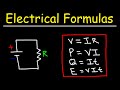
Electrical Circuits Concepts and Laws

Interactive Video
•
Physics, Science
•
9th - 12th Grade
•
Practice Problem
•
Medium

Aiden Montgomery
Used 2+ times
FREE Resource
Read more
10 questions
Show all answers
1.
MULTIPLE CHOICE QUESTION
30 sec • 1 pt
Which formula represents Ohm's Law?
E = QV
P = IV
V = IR
R = V/I
2.
MULTIPLE CHOICE QUESTION
30 sec • 1 pt
What is the unit of power in electrical circuits?
Joule
Watt
Ampere
Volt
3.
MULTIPLE CHOICE QUESTION
30 sec • 1 pt
How is electrical energy calculated using charge and voltage?
E = Pt
E = QV
E = IR
E = IVt
4.
MULTIPLE CHOICE QUESTION
30 sec • 1 pt
In a series circuit, how is the total resistance calculated?
R_total = R1 * R2 * R3
R_total = (R1 + R2 + R3)/3
1/R_total = 1/R1 + 1/R2 + 1/R3
R_total = R1 + R2 + R3
5.
MULTIPLE CHOICE QUESTION
30 sec • 1 pt
What is the relationship between current and voltage in a series circuit?
Current is divided among components
Voltage is divided among components
Voltage is the same across all components
Current is the same through all components
6.
MULTIPLE CHOICE QUESTION
30 sec • 1 pt
In a parallel circuit, how is the total current calculated?
I_total = I1 + I2 + I3
I_total = I1 * I2 * I3
I_total = I1 - I2 - I3
I_total = (I1 + I2 + I3)/3
7.
MULTIPLE CHOICE QUESTION
30 sec • 1 pt
What is Kirchhoff's Voltage Law?
The sum of currents entering a junction equals the sum leaving
The total resistance in a series circuit is the sum of individual resistances
The sum of voltages around a loop equals zero
The total current in a parallel circuit is the sum of individual currents
Access all questions and much more by creating a free account
Create resources
Host any resource
Get auto-graded reports

Continue with Google

Continue with Email

Continue with Classlink

Continue with Clever
or continue with

Microsoft
%20(1).png)
Apple

Others
Already have an account?

