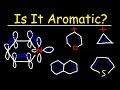
Aromatic and Anti-aromatic Compounds

Interactive Video
•
Chemistry, Science
•
10th - 12th Grade
•
Practice Problem
•
Easy

Mia Campbell
Used 2+ times
FREE Resource
Read more
10 questions
Show all answers
1.
MULTIPLE CHOICE QUESTION
30 sec • 1 pt
Which of the following is NOT a condition for a molecule to be aromatic?
The molecule must be planar.
The molecule must follow Huckel's rule.
The molecule must have sp3 hybridized carbons.
The molecule must be cyclic.
2.
MULTIPLE CHOICE QUESTION
30 sec • 1 pt
What is the main difference between aromatic and anti-aromatic compounds in terms of electron count?
Anti-aromatic compounds have an even number of pi electrons.
Aromatic compounds have an odd number of pi electrons.
Aromatic compounds follow Huckel's rule, while anti-aromatic compounds follow 4n rule.
Anti-aromatic compounds are always non-cyclic.
3.
MULTIPLE CHOICE QUESTION
30 sec • 1 pt
Which of the following statements is true about anti-aromatic compounds?
They are always non-cyclic.
They have an odd number of pi electrons.
They are less stable than non-aromatic compounds.
They are more stable than aromatic compounds.
4.
MULTIPLE CHOICE QUESTION
30 sec • 1 pt
What is the stability order of aromatic, anti-aromatic, and non-aromatic compounds?
Aromatic > Non-aromatic > Anti-aromatic
Non-aromatic > Aromatic > Anti-aromatic
Anti-aromatic > Aromatic > Non-aromatic
Non-aromatic > Anti-aromatic > Aromatic
5.
MULTIPLE CHOICE QUESTION
30 sec • 1 pt
Why is benzene considered an aromatic compound?
It is a linear molecule.
It has 6 pi electrons and follows Huckel's rule.
It is non-planar.
It has sp3 hybridized carbons.
6.
MULTIPLE CHOICE QUESTION
30 sec • 1 pt
What makes 1,3-butadiene non-aromatic?
It is cyclic.
It is not conjugated.
It has an odd number of pi electrons.
It is not cyclic.
7.
MULTIPLE CHOICE QUESTION
30 sec • 1 pt
Cyclobutadiene is considered anti-aromatic because:
It has 6 pi electrons.
It follows Huckel's rule.
It has 4 pi electrons and follows the 4n rule.
It is non-planar.
Access all questions and much more by creating a free account
Create resources
Host any resource
Get auto-graded reports

Continue with Google

Continue with Email

Continue with Classlink

Continue with Clever
or continue with

Microsoft
%20(1).png)
Apple

Others
Already have an account?
Similar Resources on Wayground

11 questions
IR Spectroscopy Concepts and Applications
Interactive video
•
10th - 12th Grade
11 questions
NMR Spectroscopy and Chemical Structure Determination
Interactive video
•
10th - 12th Grade
11 questions
Nitration of Benzene Concepts
Interactive video
•
10th - 12th Grade
8 questions
Pericyclic Reactions 4
Interactive video
•
11th Grade - University
11 questions
Carboxylic Acids and Their Properties
Interactive video
•
11th - 12th Grade
11 questions
Epoxide Chemistry Concepts
Interactive video
•
11th - 12th Grade
6 questions
Pi-n Conjugation: Unlocking the Secrets of Molecular Stability
Interactive video
•
10th Grade - University
11 questions
Free Radical Stability and Bond Cleavage
Interactive video
•
10th - 12th Grade
Popular Resources on Wayground
15 questions
Fractions on a Number Line

Quiz
•
3rd Grade
20 questions
Equivalent Fractions
Quiz
•
3rd Grade
25 questions
Multiplication Facts
Quiz
•
5th Grade
22 questions
fractions
Quiz
•
3rd Grade
20 questions
Main Idea and Details
Quiz
•
5th Grade
20 questions
Context Clues
Quiz
•
6th Grade
15 questions
Equivalent Fractions
Quiz
•
4th Grade
20 questions
Figurative Language Review
Quiz
•
6th Grade
Discover more resources for Chemistry
20 questions
Types of Chemical Reactions
Quiz
•
9th - 12th Grade
20 questions
Energy Transformations
Quiz
•
9th - 12th Grade
20 questions
Periodic Table & Trends
Quiz
•
10th Grade
17 questions
Reaction Rates
Quiz
•
11th Grade
20 questions
Periodic Trends
Quiz
•
10th Grade
24 questions
Identifying Types of Chemical Reactions
Quiz
•
10th - 12th Grade
20 questions
Naming & Writing Chemical Formulas
Quiz
•
10th Grade
20 questions
Atomic Structure
Quiz
•
10th - 12th Grade