
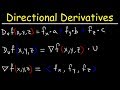
Directional Derivatives and Gradient Vectors

Interactive Video
•
Mathematics
•
10th - 12th Grade
•
Practice Problem
•
Hard

Amelia Wright
FREE Resource
Read more
10 questions
Show all answers
1.
MULTIPLE CHOICE QUESTION
30 sec • 1 pt
What is the formula for the directional derivative of a function f(x, y) in the direction of an angle?
Partial derivative of f with respect to x times b plus partial derivative of f with respect to y times a
Partial derivative of f with respect to x times c plus partial derivative of f with respect to y times d
Partial derivative of f with respect to x times a plus partial derivative of f with respect to y times b
Partial derivative of f with respect to y times a plus partial derivative of f with respect to x times b
2.
MULTIPLE CHOICE QUESTION
30 sec • 1 pt
How do you find the unit vector when given an angle?
Use cosine and sine of the angle
Divide the vector by its magnitude
Subtract the vector from its magnitude
Multiply the vector by its magnitude
3.
MULTIPLE CHOICE QUESTION
30 sec • 1 pt
What is the next step after finding the partial derivatives when evaluating the directional derivative at a point?
Add the partial derivatives
Divide by the magnitude
Substitute the given x and y values
Multiply by the angle
4.
MULTIPLE CHOICE QUESTION
30 sec • 1 pt
How do you find the unit vector of a given vector?
Multiply the vector by its magnitude
Add the vector to its magnitude
Subtract the vector from its magnitude
Divide the vector by its magnitude
5.
MULTIPLE CHOICE QUESTION
30 sec • 1 pt
What is the first step in finding the gradient vector of a function?
Find the magnitude of the function
Find the partial derivatives with respect to x and y
Multiply the function by a constant
Add the function to its derivative
6.
MULTIPLE CHOICE QUESTION
30 sec • 1 pt
What is the gradient vector of a function f(x, y) composed of?
The angle of the vector
The x and y components of the vector
The z component of the vector
The magnitude of the vector
7.
MULTIPLE CHOICE QUESTION
30 sec • 1 pt
How is the directional derivative of a three-variable function found?
By subtracting the gradient vector from the unit vector
By taking the dot product of the gradient vector and the unit vector
By adding the gradient vector and the unit vector
By multiplying the gradient vector by the unit vector
Access all questions and much more by creating a free account
Create resources
Host any resource
Get auto-graded reports

Continue with Google

Continue with Email

Continue with Classlink

Continue with Clever
or continue with

Microsoft
%20(1).png)
Apple

Others
Already have an account?

