
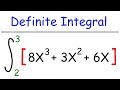
Definite Integrals and Antiderivatives

Interactive Video
•
Mathematics
•
9th - 12th Grade
•
Practice Problem
•
Hard

Aiden Montgomery
FREE Resource
Read more
10 questions
Show all answers
1.
MULTIPLE CHOICE QUESTION
30 sec • 1 pt
What distinguishes a definite integral from an indefinite integral?
A definite integral has limits of integration.
An indefinite integral is always zero.
An indefinite integral has limits of integration.
A definite integral includes a constant of integration.
2.
MULTIPLE CHOICE QUESTION
30 sec • 1 pt
What is the antiderivative of a function f(x) denoted as?
Capital G
Lowercase g
Capital F
Lowercase f
3.
MULTIPLE CHOICE QUESTION
30 sec • 1 pt
When finding the antiderivative of x^n, what is the first step?
Add one to the exponent
Subtract one from the exponent
Multiply the exponent by two
Divide the exponent by two
4.
MULTIPLE CHOICE QUESTION
30 sec • 1 pt
What is the antiderivative of 8x^3?
8x^2
2x^4
8x^4
4x^3
5.
MULTIPLE CHOICE QUESTION
30 sec • 1 pt
How do you handle the constant of integration when evaluating definite integrals?
Always include it
Ignore it
Multiply it by the limits
Subtract it from the result
6.
MULTIPLE CHOICE QUESTION
30 sec • 1 pt
What is the result of evaluating the definite integral from 2 to 3 of the function 2x^4 + x^3 + 3x^2?
162
168
164
166
7.
MULTIPLE CHOICE QUESTION
30 sec • 1 pt
What does the value of a definite integral represent in terms of geometry?
The length of the curve
The slope of the tangent line
The area under the curve
The volume of the solid
Access all questions and much more by creating a free account
Create resources
Host any resource
Get auto-graded reports

Continue with Google

Continue with Email

Continue with Classlink

Continue with Clever
or continue with

Microsoft
%20(1).png)
Apple

Others
Already have an account?
Popular Resources on Wayground

15 questions
Fractions on a Number Line

Quiz
•
3rd Grade
20 questions
Equivalent Fractions
Quiz
•
3rd Grade
25 questions
Multiplication Facts
Quiz
•
5th Grade
29 questions
Alg. 1 Section 5.1 Coordinate Plane
Quiz
•
9th Grade
22 questions
fractions
Quiz
•
3rd Grade
11 questions
FOREST Effective communication

Lesson
•
KG
20 questions
Main Idea and Details
Quiz
•
5th Grade
20 questions
Context Clues
Quiz
•
6th Grade
Discover more resources for Mathematics
29 questions
Alg. 1 Section 5.1 Coordinate Plane
Quiz
•
9th Grade
20 questions
Graphing Inequalities on a Number Line
Quiz
•
6th - 9th Grade
20 questions
Box and Whisker Plots
Quiz
•
9th Grade
18 questions
Exponential Growth and Decay
Quiz
•
9th Grade
20 questions
Function or Not a Function
Quiz
•
8th - 9th Grade
20 questions
SSS/SAS
Quiz
•
9th - 12th Grade
14 questions
Making Inferences From Samples
Quiz
•
7th - 12th Grade
23 questions
CCG - CH8 Polygon angles and area Review
Quiz
•
9th - 12th Grade