
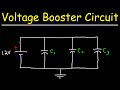
Voltage Boosting Techniques and Concepts

Interactive Video
•
Physics, Science
•
9th - 12th Grade
•
Practice Problem
•
Hard

Mia Campbell
FREE Resource
Read more
10 questions
Show all answers
1.
MULTIPLE CHOICE QUESTION
30 sec • 1 pt
Which component is NOT mentioned as a method to boost DC voltage?
Transformer
Diode
Resistor
Inductor
2.
MULTIPLE CHOICE QUESTION
30 sec • 1 pt
What is the voltage across two capacitors charged individually to 9 volts each when connected in series?
9 volts
18 volts
27 volts
36 volts
3.
MULTIPLE CHOICE QUESTION
30 sec • 1 pt
What is the initial step in boosting voltage using capacitors as described in the video?
Charging capacitors individually
Using a transformer
Connecting capacitors in series
Adding more batteries
4.
MULTIPLE CHOICE QUESTION
30 sec • 1 pt
In the example with five capacitors, what is the total voltage when they are connected in series after being charged in parallel?
60 volts
24 volts
36 volts
48 volts
5.
MULTIPLE CHOICE QUESTION
30 sec • 1 pt
What is the voltage of each capacitor when five capacitors are charged in parallel with a 12-volt battery?
6 volts
9 volts
12 volts
15 volts
6.
MULTIPLE CHOICE QUESTION
30 sec • 1 pt
What is the purpose of connecting capacitors in series after charging them in parallel?
To stabilize the current
To increase the voltage
To decrease the voltage
To reduce the resistance
7.
MULTIPLE CHOICE QUESTION
30 sec • 1 pt
What factor affects the time it takes for capacitors to charge?
Voltage
Inductance
Capacitance
Resistance
Access all questions and much more by creating a free account
Create resources
Host any resource
Get auto-graded reports

Continue with Google

Continue with Email

Continue with Microsoft
or continue with

%20(1).png)
Apple

Others
Already have an account?

