
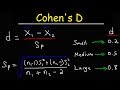
Understanding Cohen's d and Effect Size

Interactive Video
•
Mathematics, Science, Education
•
10th - 12th Grade
•
Practice Problem
•
Hard

Lucas Foster
FREE Resource
Read more
10 questions
Show all answers
1.
MULTIPLE CHOICE QUESTION
30 sec • 1 pt
What does a Cohen's d value of 1 indicate about the difference between two sample means?
The difference is equal to one standard deviation.
The difference is equal to two standard deviations.
The difference is equal to half a standard deviation.
The difference is equal to three standard deviations.
2.
MULTIPLE CHOICE QUESTION
30 sec • 1 pt
If Cohen's d is 0.2, how is the effect size categorized?
Small
Very Large
Medium
Large
3.
MULTIPLE CHOICE QUESTION
30 sec • 1 pt
What is the formula for calculating Cohen's d?
Difference between sample means divided by pooled standard deviation.
Sum of sample means divided by pooled standard deviation.
Sum of sample means multiplied by pooled standard deviation.
Difference between sample means multiplied by pooled standard deviation.
4.
MULTIPLE CHOICE QUESTION
30 sec • 1 pt
In the first example, what is the pooled standard deviation calculated using the given data?
3.5355
4.5355
2.5355
5.5355
5.
MULTIPLE CHOICE QUESTION
30 sec • 1 pt
When can the alternative formula for pooled standard deviation be used?
When sample sizes are equal or very close.
When sample sizes are significantly different.
When standard deviations are equal.
When means are equal.
6.
MULTIPLE CHOICE QUESTION
30 sec • 1 pt
What is the Cohen's d value calculated for the first example?
0.7485
0.8485
0.6485
0.5485
7.
MULTIPLE CHOICE QUESTION
30 sec • 1 pt
In the second example, what is the pooled standard deviation calculated using the correct formula?
7.1539
6.1539
5.1539
8.1539
Access all questions and much more by creating a free account
Create resources
Host any resource
Get auto-graded reports

Continue with Google

Continue with Email

Continue with Classlink

Continue with Clever
or continue with

Microsoft
%20(1).png)
Apple

Others
Already have an account?

