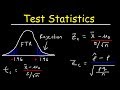
Hypothesis Testing and Z Values

Interactive Video
•
Mathematics, Science
•
10th - 12th Grade
•
Practice Problem
•
Hard

Lucas Foster
FREE Resource
Read more
10 questions
Show all answers
1.
MULTIPLE CHOICE QUESTION
30 sec • 1 pt
What is the null hypothesis in hypothesis testing?
The hypothesis that the mean is different from a specified value.
The hypothesis that the mean is less than a specified value.
The hypothesis that the mean is equal to a specified value.
The hypothesis that the mean is greater than a specified value.
2.
MULTIPLE CHOICE QUESTION
30 sec • 1 pt
What is the rejection region in hypothesis testing?
The area where the null hypothesis is accepted.
The area where the null hypothesis is rejected.
The area where the alternative hypothesis is rejected.
The area where the alternative hypothesis is accepted.
3.
MULTIPLE CHOICE QUESTION
30 sec • 1 pt
What are critical values used for in hypothesis testing?
To calculate the mean of the sample.
To find the standard deviation of the population.
To separate the rejection and fail to reject regions.
To determine the sample size.
4.
MULTIPLE CHOICE QUESTION
30 sec • 1 pt
In hypothesis testing, what does a 95% confidence level imply?
The critical values are set to 1.96 on both sides.
The probability of rejecting the null hypothesis is 95%.
The sample mean is within 95% of the population mean.
The probability of not rejecting the null hypothesis is 95%.
5.
MULTIPLE CHOICE QUESTION
30 sec • 1 pt
How do you decide to reject the null hypothesis using the calculated z value?
If the calculated z value is equal to the critical value.
If the calculated z value is less than zero.
If the calculated z value is in the rejection region.
If the calculated z value is in the fail to reject region.
6.
MULTIPLE CHOICE QUESTION
30 sec • 1 pt
When should you use the t distribution in hypothesis testing?
When the sample size is greater than 30 and the population standard deviation is known.
When the sample size is less than 30 and the population standard deviation is unknown.
When the sample size is greater than 30 and the population standard deviation is unknown.
When the sample size is less than 30 and the population standard deviation is known.
7.
MULTIPLE CHOICE QUESTION
30 sec • 1 pt
What formula is used to calculate the z value when the population standard deviation is known?
Sample mean plus population mean divided by population standard deviation over the square root of n.
Sample mean minus population mean divided by population standard deviation over the square root of n.
Sample mean minus population mean divided by sample standard deviation over the square root of n.
Sample mean plus population mean divided by sample standard deviation over the square root of n.
Access all questions and much more by creating a free account
Create resources
Host any resource
Get auto-graded reports

Continue with Google

Continue with Email

Continue with Classlink

Continue with Clever
or continue with

Microsoft
%20(1).png)
Apple

Others
Already have an account?
Popular Resources on Wayground

15 questions
Fractions on a Number Line

Quiz
•
3rd Grade
20 questions
Equivalent Fractions
Quiz
•
3rd Grade
25 questions
Multiplication Facts
Quiz
•
5th Grade
22 questions
fractions
Quiz
•
3rd Grade
20 questions
Main Idea and Details
Quiz
•
5th Grade
20 questions
Context Clues
Quiz
•
6th Grade
15 questions
Equivalent Fractions
Quiz
•
4th Grade
20 questions
Figurative Language Review
Quiz
•
6th Grade
Discover more resources for Mathematics
25 questions
Complementary and Supplementary Angles
Quiz
•
7th - 10th Grade
12 questions
Add and Subtract Polynomials
Quiz
•
9th - 12th Grade
13 questions
Model Exponential Growth and Decay Scenarios
Quiz
•
9th - 12th Grade
27 questions
7.2.3 Quadrilateral Properties
Quiz
•
9th - 12th Grade
16 questions
Converting Improper Fractions to Mixed Numbers
Quiz
•
4th - 10th Grade
10 questions
Simplifying Expressions by Combining Like Terms
Interactive video
•
6th - 10th Grade
10 questions
Simplifying Expressions with the Distributive Property
Interactive video
•
6th - 10th Grade
10 questions
Key Features of Quadratic Functions
Interactive video
•
8th - 12th Grade