
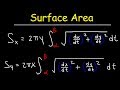
Surface Area of Revolution Problems

Interactive Video
•
Mathematics
•
10th - 12th Grade
•
Practice Problem
•
Hard
Standards-aligned

Emma Peterson
FREE Resource
Standards-aligned
Read more
10 questions
Show all answers
1.
MULTIPLE CHOICE QUESTION
30 sec • 1 pt
What is the first step in finding the surface area of revolution for a parametric function?
Find the derivatives dx/dt and dy/dt.
Directly apply the surface area formula.
Determine the limits of integration.
Calculate the volume of revolution.
2.
MULTIPLE CHOICE QUESTION
30 sec • 1 pt
Which formula is used to find the surface area of revolution about the x-axis?
2πx times the integral of the square root of (dx/dt)^2 + (dy/dt)^2
2π times the integral of (dx/dt)^2 + (dy/dt)^2
2πy times the integral of the square root of (dx/dt)^2 + (dy/dt)^2
π times the integral of the square root of (dx/dt)^2 + (dy/dt)^2
3.
MULTIPLE CHOICE QUESTION
30 sec • 1 pt
What substitution is used to simplify the integral in the x-axis rotation problem?
u = t^3 + 8
u = t^2 + 4
u = 4t^2 + 64
u = 2t + 8
4.
MULTIPLE CHOICE QUESTION
30 sec • 1 pt
What is the result of evaluating the integral from 64 to 80 in the x-axis rotation problem?
203.542
715.542
512
852.459
5.
MULTIPLE CHOICE QUESTION
30 sec • 1 pt
How does the formula for surface area change when rotating about the y-axis?
It uses π instead of 2π.
It uses 2πy instead of 2πx.
It uses 2πx instead of 2πy.
It remains the same.
6.
MULTIPLE CHOICE QUESTION
30 sec • 1 pt
What is the expression for dx/dt in the y-axis rotation problem?
t^3
2t
t^2
3t^2
7.
MULTIPLE CHOICE QUESTION
30 sec • 1 pt
What substitution is used in the y-axis rotation problem to simplify the integral?
u = t^3 + 9
u = 9t^2 + 64
u = t^2 + 4
u = 4 + 9t^2
Tags
CCSS.HSG.SRT.C.8
Access all questions and much more by creating a free account
Create resources
Host any resource
Get auto-graded reports

Continue with Google

Continue with Email

Continue with Microsoft
or continue with

%20(1).png)
Apple

Others
By signing up, you agree to our Terms of Service & Privacy Policy
Already have an account?

