
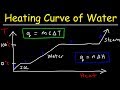
Understanding Heating and Cooling Curves of Water

Interactive Video
•
Physics, Chemistry, Science
•
9th - 12th Grade
•
Practice Problem
•
Medium

Amelia Wright
Used 20+ times
FREE Resource
Read more
10 questions
Show all answers
1.
MULTIPLE CHOICE QUESTION
30 sec • 1 pt
What happens to the temperature of ice as it is heated from -20°C to 0°C?
It decreases.
It increases.
It remains constant.
It fluctuates.
2.
MULTIPLE CHOICE QUESTION
30 sec • 1 pt
During the phase change from ice to liquid water, what type of energy increases?
Thermal energy
Potential energy
Mechanical energy
Kinetic energy
3.
MULTIPLE CHOICE QUESTION
30 sec • 1 pt
What is the enthalpy of vaporization for water?
4.18 kJ/mol
40.7 kJ/mol
6 kJ/mol
2 kJ/mol
4.
MULTIPLE CHOICE QUESTION
30 sec • 1 pt
How does the specific heat capacity of water affect the slope of its heating curve?
Higher specific heat capacity results in a steeper slope.
The slope is always constant regardless of specific heat capacity.
Lower specific heat capacity results in a steeper slope.
Specific heat capacity does not affect the slope.
5.
MULTIPLE CHOICE QUESTION
30 sec • 1 pt
Why does steam have a steeper slope on the heating curve compared to liquid water?
Steam absorbs more heat energy.
Steam has a higher specific heat capacity.
Steam releases more heat energy.
Steam has a lower specific heat capacity.
6.
MULTIPLE CHOICE QUESTION
30 sec • 1 pt
What type of process is the cooling curve of water?
Endothermic
Exothermic
Isothermal
Adiabatic
7.
MULTIPLE CHOICE QUESTION
30 sec • 1 pt
During the cooling curve, what happens to the potential energy of steam as it condenses?
It remains constant.
It decreases.
It fluctuates.
It increases.
Access all questions and much more by creating a free account
Create resources
Host any resource
Get auto-graded reports

Continue with Google

Continue with Email

Continue with Classlink

Continue with Clever
or continue with

Microsoft
%20(1).png)
Apple

Others
Already have an account?

