
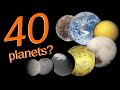
The Mysteries Of Our Solar System And The Planetary Debate

Interactive Video
•
Science, Physics, Geography
•
9th - 12th Grade
•
Practice Problem
•
Hard

Patricia Brown
FREE Resource
Read more
10 questions
Show all answers
1.
MULTIPLE CHOICE QUESTION
30 sec • 1 pt
How many planets are traditionally recognized in our solar system according to the IAU?
8
9
10
7
2.
MULTIPLE CHOICE QUESTION
30 sec • 1 pt
What is one of the main reasons Pluto was reclassified as a dwarf planet?
It is not round
It does not orbit the Sun
It has not cleared its orbital neighborhood
It is too far from the Sun
3.
MULTIPLE CHOICE QUESTION
30 sec • 1 pt
According to Alan Stern and Harold Leveson, what is a key criterion for a planetary body?
It must have a magnetic field
It must be large enough for gravity to shape it
It must orbit a star
It must have an atmosphere
4.
MULTIPLE CHOICE QUESTION
30 sec • 1 pt
Which of the following was once considered a planet in the ancient Mediterranean?
Jupiter
Mars
The Moon
Venus
5.
MULTIPLE CHOICE QUESTION
30 sec • 1 pt
What is the name of the largest asteroid that was once considered a planet?
Hygieia
Pallas
Ceres
Vesta
6.
MULTIPLE CHOICE QUESTION
30 sec • 1 pt
Which of the following is a recognized dwarf planet in the Kuiper Belt?
Makemake
Ganymede
Titan
Phobos
7.
MULTIPLE CHOICE QUESTION
30 sec • 1 pt
What is the name of the hypothetical planet that could explain the orbits of distant objects like Sedna?
Planet X
Vulcan
Planet 9
Nibiru
Access all questions and much more by creating a free account
Create resources
Host any resource
Get auto-graded reports

Continue with Google

Continue with Email

Continue with Microsoft
or continue with

%20(1).png)
Apple

Others
Already have an account?


