
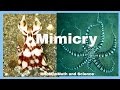
Nature's Clever Disguises: The Art of Mimicry in Animals and Plants

Interactive Video
•
Biology, Science, Other
•
5th - 6th Grade
•
Practice Problem
•
Hard

Patricia Brown
FREE Resource
Read more
10 questions
Show all answers
1.
MULTIPLE CHOICE QUESTION
30 sec • 1 pt
What is the primary purpose of mimicry in nature?
For defense or to gain an advantage
To attract mates
To find food
To migrate
2.
MULTIPLE CHOICE QUESTION
30 sec • 1 pt
How does the king snake benefit from resembling the coral snake?
It can climb trees better
It attracts more prey
It becomes more venomous
It scares away predators
3.
MULTIPLE CHOICE QUESTION
30 sec • 1 pt
What unique behavior does the Western hognose snake exhibit when threatened?
It changes color
It digs underground
It plays dead
It flies away
4.
MULTIPLE CHOICE QUESTION
30 sec • 1 pt
Which insect mimics an ant during its early larval stage?
Butterfly
Bee
Cricket
Grasshopper
5.
MULTIPLE CHOICE QUESTION
30 sec • 1 pt
How does the fork-tailed drongo use mimicry to its advantage?
By mimicking the appearance of a predator
By mimicking the sound of alarms to scare other animals
By mimicking the scent of flowers
By changing its color to blend in
6.
MULTIPLE CHOICE QUESTION
30 sec • 1 pt
What feature does the northern pygmy owl use to mimic itself?
Its wings
Fake eyes on the back of its head
Its beak
Its tail
7.
MULTIPLE CHOICE QUESTION
30 sec • 1 pt
What does the elephant hawk moth caterpillar mimic to deter predators?
A flower
A leaf
A snake
A bird
Access all questions and much more by creating a free account
Create resources
Host any resource
Get auto-graded reports

Continue with Google

Continue with Email

Continue with Microsoft
or continue with

%20(1).png)
Apple

Others
Already have an account?



