
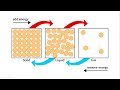
Unraveling The Particle Theory Of Matter

Interactive Video
•
Physics, Chemistry, Science
•
6th - 8th Grade
•
Practice Problem
•
Hard

Patricia Brown
FREE Resource
Read more
10 questions
Show all answers
1.
MULTIPLE CHOICE QUESTION
30 sec • 1 pt
What is the primary purpose of the particle theory of matter?
To explain the structure and behavior of matter
To identify the chemical composition of elements
To measure the weight of particles
To describe the color of substances
2.
MULTIPLE CHOICE QUESTION
30 sec • 1 pt
What are the tiny objects that make up all matter called?
Cells
Particles
Molecules
Atoms
3.
MULTIPLE CHOICE QUESTION
30 sec • 1 pt
How does the space between particles vary in different states of matter?
It is the same in liquids and gases
It is smallest in solids and largest in gases
It is smallest in gases and largest in solids
It remains constant in all states
4.
MULTIPLE CHOICE QUESTION
30 sec • 1 pt
In which state of matter do particles primarily vibrate in place?
Gas
Liquid
Solid
Plasma
5.
MULTIPLE CHOICE QUESTION
30 sec • 1 pt
What happens to the attraction between particles as they gain energy?
It decreases
It increases
It becomes unpredictable
It remains unchanged
6.
MULTIPLE CHOICE QUESTION
30 sec • 1 pt
During the melting of water, what allows particles to slide past each other?
Decreased motion
Increased energy
Decreased energy
Increased attraction
7.
MULTIPLE CHOICE QUESTION
30 sec • 1 pt
What is the state of matter when particles have a lot of motion and are not well attracted to each other?
Plasma
Liquid
Gas
Solid
Access all questions and much more by creating a free account
Create resources
Host any resource
Get auto-graded reports

Continue with Google

Continue with Email

Continue with Microsoft
or continue with

%20(1).png)
Apple

Others
Already have an account?

