
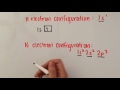
Mastering Orbital Diagrams and Electron Configurations in Chemistry

Interactive Video
•
Chemistry, Physics, Science
•
9th - 10th Grade
•
Practice Problem
•
Hard

Patricia Brown
FREE Resource
Read more
8 questions
Show all answers
1.
MULTIPLE CHOICE QUESTION
30 sec • 1 pt
What is the first step in drawing an orbital diagram?
List all the electrons
Draw a line or box for each shell
Calculate the atomic mass
Write the element's name
2.
MULTIPLE CHOICE QUESTION
30 sec • 1 pt
How is an electron represented in an orbital diagram?
With a square
With a triangle
With a circle
With a half up arrow and a half down arrow
3.
MULTIPLE CHOICE QUESTION
30 sec • 1 pt
In the context of orbital diagrams, what does Pauli's rule state?
Electrons should be placed in the lowest energy level first
Electrons should be placed in the highest energy level first
Electrons in the same sublevel must have opposite spins
Electrons must be paired in the same direction
4.
MULTIPLE CHOICE QUESTION
30 sec • 1 pt
How many electrons can the P block hold?
Eight
Six
Four
Two
5.
MULTIPLE CHOICE QUESTION
30 sec • 1 pt
What is the main principle of Hund's rule?
Electrons should be placed in the highest energy level first
Fill each orbital with one electron before pairing them
Electrons should be placed in the lowest energy level first
Fill each orbital with two electrons before moving to the next
6.
MULTIPLE CHOICE QUESTION
30 sec • 1 pt
Why is it important to follow Hund's rule when filling orbitals?
To minimize the number of electrons
To ensure the highest energy state
To maximize the number of electrons
To ensure the lowest energy state
7.
MULTIPLE CHOICE QUESTION
30 sec • 1 pt
What is incorrect about placing electrons in the same orbital without following Hund's rule?
It causes the atom to lose electrons
It makes the atom more reactive
It results in higher energy and less stability
It leads to incorrect atomic mass
Access all questions and much more by creating a free account
Create resources
Host any resource
Get auto-graded reports

Continue with Google

Continue with Email

Continue with Microsoft
or continue with

%20(1).png)
Apple

Others
By signing up, you agree to our Terms of Service & Privacy Policy
Already have an account?

