
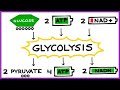
Aerobic Respiration: Converting Glucose Into Energy

Interactive Video
•
Biology, Science, Chemistry
•
9th - 10th Grade
•
Practice Problem
•
Hard

Patricia Brown
FREE Resource
Read more
10 questions
Show all answers
1.
MULTIPLE CHOICE QUESTION
30 sec • 1 pt
What is the main difference between photosynthesis and respiration?
Photosynthesis converts glucose into ATP, while respiration converts ATP into glucose.
Photosynthesis occurs in mitochondria, while respiration occurs in chloroplasts.
Photosynthesis converts water and carbon dioxide into glucose, while respiration converts glucose into ATP.
Photosynthesis and respiration both produce oxygen as a byproduct.
2.
MULTIPLE CHOICE QUESTION
30 sec • 1 pt
Which of the following is true about aerobic respiration?
It produces lactic acid as a byproduct.
It occurs in the absence of oxygen.
It produces less ATP than anaerobic respiration.
It is more efficient and sustainable for long periods.
3.
MULTIPLE CHOICE QUESTION
30 sec • 1 pt
What is the initial step common to both aerobic and anaerobic respiration?
Krebs cycle
Electron transport chain
Glycolysis
Prep steps
4.
MULTIPLE CHOICE QUESTION
30 sec • 1 pt
How many ATP molecules are produced during glycolysis per glucose molecule?
4 ATP
8 ATP
2 ATP
6 ATP
5.
MULTIPLE CHOICE QUESTION
30 sec • 1 pt
What is the net gain of ATP molecules after glycolysis?
1 ATP
2 ATP
4 ATP
3 ATP
6.
MULTIPLE CHOICE QUESTION
30 sec • 1 pt
During the prep steps, what is pyruvate converted into?
NADPH
Lactic acid
Acetyl-CoA
Glucose
7.
MULTIPLE CHOICE QUESTION
30 sec • 1 pt
What is produced alongside acetyl-CoA during the prep steps?
Glucose
Carbon dioxide
Water
Oxygen
Access all questions and much more by creating a free account
Create resources
Host any resource
Get auto-graded reports

Continue with Google

Continue with Email

Continue with Microsoft
or continue with

%20(1).png)
Apple

Others
Already have an account?


