
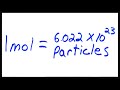
Converting Moles to Particles in Chemistry and Physics

Interactive Video
•
Chemistry, Science, Physics
•
9th - 10th Grade
•
Practice Problem
•
Hard

Patricia Brown
FREE Resource
Read more
8 questions
Show all answers
1.
MULTIPLE CHOICE QUESTION
30 sec • 1 pt
What types of particles can be involved in conversions between moles and particles?
Only atoms
Only molecules
Atoms, molecules, or ions
Only ions
2.
MULTIPLE CHOICE QUESTION
30 sec • 1 pt
What is the conversion factor used to convert moles of water to water molecules?
1 mole = 6.022 x 10^23 water molecules
1 mole = 1 x 10^20 water molecules
1 mole = 1 x 10^23 water molecules
1 mole = 6.022 x 10^20 water molecules
3.
MULTIPLE CHOICE QUESTION
30 sec • 1 pt
When converting moles to particles, where should the moles be placed in the conversion factor?
On the bottom
On the top
In the middle
It doesn't matter
4.
MULTIPLE CHOICE QUESTION
30 sec • 1 pt
How many water molecules are equivalent to 1.2 moles of water?
3.7 x 10^23
6.1 x 10^23
7.2 x 10^23
1.2 x 10^23
5.
MULTIPLE CHOICE QUESTION
30 sec • 1 pt
What is the first step in converting sodium atoms to moles?
Multiply by Avogadro's number
Set up a conversion factor
Divide by the atomic mass
Add the number of atoms
6.
MULTIPLE CHOICE QUESTION
30 sec • 1 pt
How many moles of sodium are equivalent to 3.7 x 10^20 sodium atoms?
3.7 x 10^-4
7.2 x 10^-4
1.2 x 10^-4
6.1 x 10^-4
7.
MULTIPLE CHOICE QUESTION
30 sec • 1 pt
What is Avogadro's number used for in these conversions?
To find the mass of a substance
To convert between moles and particles
To calculate the volume of a gas
To determine the density of a liquid
Access all questions and much more by creating a free account
Create resources
Host any resource
Get auto-graded reports

Continue with Google

Continue with Email

Continue with Classlink

Continue with Clever
or continue with

Microsoft
%20(1).png)
Apple

Others
Already have an account?

