
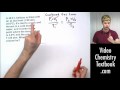
Gas Laws in Action: Understanding the Combined Gas Law and Its Applications

Interactive Video
•
Physics, Chemistry, Science
•
9th - 10th Grade
•
Practice Problem
•
Hard

Patricia Brown
FREE Resource
Read more
10 questions
Show all answers
1.
MULTIPLE CHOICE QUESTION
30 sec • 1 pt
Which two variables does Boyle's Law relate?
Temperature and Volume
Pressure and Volume
Volume and Temperature
Pressure and Temperature
2.
MULTIPLE CHOICE QUESTION
30 sec • 1 pt
What is the main limitation of the three fundamental gas laws?
They do not consider changes in pressure.
They cannot be used for solids.
They only relate two variables at a time.
They are only applicable at high temperatures.
3.
MULTIPLE CHOICE QUESTION
30 sec • 1 pt
What does the Combined Gas Law allow you to calculate?
Changes in pressure, volume, and temperature
Changes in density
Changes in chemical composition
Changes in molecular weight
4.
MULTIPLE CHOICE QUESTION
30 sec • 1 pt
In the practical problem, what is the initial pressure of the balloon at sea level?
1.00 atm
11.00 atm
0.50 atm
4.00 atm
5.
MULTIPLE CHOICE QUESTION
30 sec • 1 pt
What is the final temperature of the balloon when it is submerged in water?
25.0 degrees Celsius
4.0 degrees Celsius
11.0 degrees Celsius
40.0 degrees Celsius
6.
MULTIPLE CHOICE QUESTION
30 sec • 1 pt
What is the first step in rearranging the Combined Gas Law to solve for V2?
Subtract V1 from both sides
Divide both sides by T1
Multiply both sides by T2
Add P1 to both sides
7.
MULTIPLE CHOICE QUESTION
30 sec • 1 pt
Why is it necessary to convert temperatures from Celsius to Kelvin in gas law calculations?
Kelvin is easier to calculate
Celsius is not accurate
Kelvin is the standard unit for gas calculations
Kelvin is a larger unit
Access all questions and much more by creating a free account
Create resources
Host any resource
Get auto-graded reports

Continue with Google

Continue with Email

Continue with Microsoft
or continue with

%20(1).png)
Apple

Others
Already have an account?



