
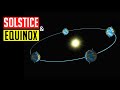
Seasons Explained: Solstices and Equinoxes in Science and Geography

Interactive Video
•
Science, Geography, Physics
•
6th - 8th Grade
•
Practice Problem
•
Hard

Patricia Brown
FREE Resource
Read more
10 questions
Show all answers
1.
MULTIPLE CHOICE QUESTION
30 sec • 1 pt
What causes the different seasons on Earth?
The distance of Earth from the Sun
The tilt of Earth's axis
The speed of Earth's rotation
The shape of Earth's orbit
2.
MULTIPLE CHOICE QUESTION
30 sec • 1 pt
What is the main characteristic of a solstice?
Longest or shortest day of the year
Equal day and night
Sun directly over the equator
Sun directly over the poles
3.
MULTIPLE CHOICE QUESTION
30 sec • 1 pt
In the northern hemisphere, when does the summer solstice occur?
Around September 23rd
Around June 21st
Around December 21st
Around March 21st
4.
MULTIPLE CHOICE QUESTION
30 sec • 1 pt
Which hemisphere experiences summer in December?
Northern hemisphere
Neither hemisphere
Southern hemisphere
Both hemispheres
5.
MULTIPLE CHOICE QUESTION
30 sec • 1 pt
What marks the beginning of spring in the northern hemisphere?
Winter solstice
Summer solstice
Vernal equinox
Autumnal equinox
6.
MULTIPLE CHOICE QUESTION
30 sec • 1 pt
During an equinox, what is true about the length of day and night?
Day and night are of equal length
Night is longer than day
Day is longer than night
Day and night lengths vary by location
7.
MULTIPLE CHOICE QUESTION
30 sec • 1 pt
What does the term 'equi' in equinox mean?
Sun
Night
Day
Equal
Access all questions and much more by creating a free account
Create resources
Host any resource
Get auto-graded reports

Continue with Google

Continue with Email

Continue with Classlink

Continue with Clever
or continue with

Microsoft
%20(1).png)
Apple

Others
Already have an account?


