
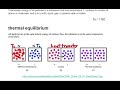
Thermal Energy Dynamics and Equilibrium Explained Through Particle Motion

Interactive Video
•
Physics, Science, Chemistry
•
9th - 10th Grade
•
Practice Problem
•
Hard

Patricia Brown
FREE Resource
Read more
10 questions
Show all answers
1.
MULTIPLE CHOICE QUESTION
30 sec • 1 pt
What is thermal energy primarily concerned with?
Nuclear energy of atoms
Chemical energy of substances
Total kinetic energy of particles
Potential energy of particles
2.
MULTIPLE CHOICE QUESTION
30 sec • 1 pt
What is required to study thermal energy and thermal equilibrium?
Insight into magnetic fields
Familiarity with electrical circuits
Knowledge of chemical reactions
Understanding of particle motion and energy transfer
3.
MULTIPLE CHOICE QUESTION
30 sec • 1 pt
In the context of thermal energy, what does a higher temperature indicate?
Less energy in the system
Faster particle movement
Slower particle movement
More particles in the substance
4.
MULTIPLE CHOICE QUESTION
30 sec • 1 pt
How does the thermal energy of a box with hot particles compare to one with cooler particles?
It is lower
It is the same
It depends on the color of the box
It is higher
5.
MULTIPLE CHOICE QUESTION
30 sec • 1 pt
Which state of matter is primarily discussed in the video?
Plasma
Gas
Liquid
Solid
6.
MULTIPLE CHOICE QUESTION
30 sec • 1 pt
What is avoided in the discussion of thermal energy in the video?
Liquid state
Gas state
Solid state
Plasma state
7.
MULTIPLE CHOICE QUESTION
30 sec • 1 pt
What happens when a hot box is placed next to a cold box?
Heat transfers from cold to hot
Heat transfers from hot to cold
No heat transfer occurs
Heat transfers in both directions equally
Access all questions and much more by creating a free account
Create resources
Host any resource
Get auto-graded reports

Continue with Google

Continue with Email

Continue with Classlink

Continue with Clever
or continue with

Microsoft
%20(1).png)
Apple

Others
Already have an account?


