
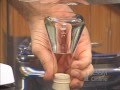
Charles's Law Experiment: Exploring Gas Volume and Temperature Relationships

Interactive Video
•
Physics, Chemistry, Science
•
9th - 10th Grade
•
Practice Problem
•
Hard

Patricia Brown
FREE Resource
Read more
10 questions
Show all answers
1.
MULTIPLE CHOICE QUESTION
30 sec • 1 pt
What is the main focus of Charles's Law in this experiment?
Volume versus mass relationship
Volume versus temperature relationship
Pressure versus temperature relationship
Pressure versus volume relationship
2.
MULTIPLE CHOICE QUESTION
30 sec • 1 pt
Which flask size is used first in the boiling water bath?
1,000 milliliter flask
500 milliliter flask
125 milliliter flask
250 milliliter flask
3.
MULTIPLE CHOICE QUESTION
30 sec • 1 pt
What happens to the gas inside the flask when it is heated in the boiling water bath?
It evaporates
It expands
It remains the same
It contracts
4.
MULTIPLE CHOICE QUESTION
30 sec • 1 pt
How is the air trapped inside the flask during the experiment?
By sealing the flask with a lid
By using a vacuum pump
By placing a fingertip over the glass tubing
By using a rubber band
5.
MULTIPLE CHOICE QUESTION
30 sec • 1 pt
What is the purpose of inverting the flask in the water tank?
To measure the gas pressure
To mix the gas with water
To allow the gas to cool
To heat the gas further
6.
MULTIPLE CHOICE QUESTION
30 sec • 1 pt
What causes the water to rise into the flask as the gas cools?
Magnetic force
Atmospheric pressure
Centrifugal force
Gravity
7.
MULTIPLE CHOICE QUESTION
30 sec • 1 pt
What is the volume of water measured in the graduated cylinder after cooling?
500 milliliters
26.5 milliliters
125 milliliters
138 milliliters
Access all questions and much more by creating a free account
Create resources
Host any resource
Get auto-graded reports

Continue with Google

Continue with Email

Continue with Classlink

Continue with Clever
or continue with

Microsoft
%20(1).png)
Apple

Others
Already have an account?


