
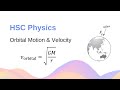
Orbital Motion of Satellites and Planets Explained

Interactive Video
•
Physics, Mathematics, Science
•
9th - 12th Grade
•
Practice Problem
•
Hard

Patricia Brown
FREE Resource
Read more
10 questions
Show all answers
1.
MULTIPLE CHOICE QUESTION
30 sec • 1 pt
What force keeps a satellite in uniform circular motion around Earth?
Centripetal force
Frictional force
Electromagnetic force
Nuclear force
2.
MULTIPLE CHOICE QUESTION
30 sec • 1 pt
Which factor does NOT affect the orbital velocity of a satellite?
Gravitational constant
Distance from Earth's center
Mass of the Earth
Mass of the satellite
3.
MULTIPLE CHOICE QUESTION
30 sec • 1 pt
What is the relationship between orbital velocity and the distance from the center of Earth?
No relationship
Inversely proportional
Exponentially proportional
Directly proportional
4.
MULTIPLE CHOICE QUESTION
30 sec • 1 pt
What is the formula for calculating the orbital velocity of a satellite?
v = √(r/gM)
v = gM²/r
v = gM/r
v = √(gM/r)
5.
MULTIPLE CHOICE QUESTION
30 sec • 1 pt
If a satellite's velocity increases beyond the required orbital velocity, what happens to its orbit?
The orbit becomes elliptical
The orbital radius decreases
The satellite crashes into Earth
The orbital radius increases
6.
MULTIPLE CHOICE QUESTION
30 sec • 1 pt
What happens to the orbital path if a satellite's speed is less than the required orbital velocity?
The orbital radius decreases
The satellite escapes Earth's gravity
The satellite maintains its orbit
The orbital radius increases
7.
MULTIPLE CHOICE QUESTION
30 sec • 1 pt
What is the orbital velocity of a satellite 500 km above Earth's surface?
8,000 m/s
6,974 m/s
7,500 m/s
5,000 m/s
Access all questions and much more by creating a free account
Create resources
Host any resource
Get auto-graded reports

Continue with Google

Continue with Email

Continue with Classlink

Continue with Clever
or continue with

Microsoft
%20(1).png)
Apple

Others
Already have an account?

