
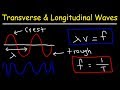
Waves Unveiled: Exploring Transverse and Longitudinal Wave Properties

Interactive Video
•
Physics, Science, Mathematics
•
9th - 10th Grade
•
Practice Problem
•
Hard

Patricia Brown
FREE Resource
Read more
10 questions
Show all answers
1.
MULTIPLE CHOICE QUESTION
30 sec • 1 pt
What is the top part of a wave called?
Trough
Wavelength
Crest
Amplitude
2.
MULTIPLE CHOICE QUESTION
30 sec • 1 pt
How can the speed of a wave be calculated?
By dividing wavelength by frequency
By adding wavelength and frequency
By multiplying wavelength by frequency
By subtracting frequency from wavelength
3.
MULTIPLE CHOICE QUESTION
30 sec • 1 pt
What unit is used to measure frequency?
Newtons
Hertz
Seconds
Meters
4.
MULTIPLE CHOICE QUESTION
30 sec • 1 pt
In which direction do the oscillations occur in a transverse wave?
Opposite to wave motion
Perpendicular to wave motion
In the same direction as wave motion
Parallel to wave motion
5.
MULTIPLE CHOICE QUESTION
30 sec • 1 pt
Which of the following is an example of a transverse wave?
Seismic wave
Pressure wave
Water wave
Sound wave
6.
MULTIPLE CHOICE QUESTION
30 sec • 1 pt
What is a characteristic feature of longitudinal waves?
Oscillations are perpendicular to wave motion
They only occur in liquids
Oscillations are parallel to wave motion
They do not have oscillations
7.
MULTIPLE CHOICE QUESTION
30 sec • 1 pt
Which of the following is a good example of a longitudinal wave?
Sound wave
Radio wave
Light wave
Gamma ray
Access all questions and much more by creating a free account
Create resources
Host any resource
Get auto-graded reports

Continue with Google

Continue with Email

Continue with Classlink

Continue with Clever
or continue with

Microsoft
%20(1).png)
Apple

Others
Already have an account?

