
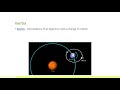
Gravity and Inertia: Exploring Orbital Forces and Motion Effects

Interactive Video
•
Physics, Science, Other
•
6th - 8th Grade
•
Practice Problem
•
Hard

Patricia Brown
FREE Resource
Read more
10 questions
Show all answers
1.
MULTIPLE CHOICE QUESTION
30 sec • 1 pt
Who was the first person to explain why the Earth and Moon remain in orbit?
Nikola Tesla
Albert Einstein
Galileo Galilei
Isaac Newton
2.
MULTIPLE CHOICE QUESTION
30 sec • 1 pt
According to Newton's law of universal gravitation, what two factors determine the strength of gravitational force between two objects?
Volume and speed
Distance and speed
Mass and distance
Mass and volume
3.
MULTIPLE CHOICE QUESTION
30 sec • 1 pt
What happens to the gravitational force between two objects as the distance between them increases?
It increases
It remains the same
It decreases
It becomes zero
4.
MULTIPLE CHOICE QUESTION
30 sec • 1 pt
What is the tendency of an object to resist changes in its state of motion called?
Gravity
Velocity
Momentum
Inertia
5.
MULTIPLE CHOICE QUESTION
30 sec • 1 pt
According to Newton's first law of motion, what will an object in motion do if no unbalanced force acts on it?
It will continue moving at a constant speed
It will change direction
It will stop
It will accelerate
6.
MULTIPLE CHOICE QUESTION
30 sec • 1 pt
What is the effect of increased mass on an object's inertia?
It has no effect on inertia
It increases inertia
It reverses inertia
It decreases inertia
7.
MULTIPLE CHOICE QUESTION
30 sec • 1 pt
Why doesn't the Earth fall into the Sun despite the gravitational pull?
Because of the Sun's rotation
Because of Earth's atmosphere
Because of Earth's inertia
Because of the Moon's gravity
Access all questions and much more by creating a free account
Create resources
Host any resource
Get auto-graded reports

Continue with Google

Continue with Email

Continue with Classlink

Continue with Clever
or continue with

Microsoft
%20(1).png)
Apple

Others
Already have an account?

