
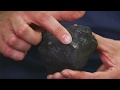
Identifying Meteorites and Their Earthly Impostors

Interactive Video
•
Science
•
6th - 7th Grade
•
Practice Problem
•
Hard

Patricia Brown
FREE Resource
Read more
8 questions
Show all answers
1.
MULTIPLE CHOICE QUESTION
30 sec • 1 pt
What is a common misconception about meteorites?
They are very common on Earth.
They are always small.
They are always shiny.
They are mostly found in deserts.
2.
MULTIPLE CHOICE QUESTION
30 sec • 1 pt
Which test can help determine if a rock is a meteorite based on its weight?
Check if it floats in water.
See if it feels unusually heavy for its size.
Check if it is transparent.
Look for a shiny surface.
3.
MULTIPLE CHOICE QUESTION
30 sec • 1 pt
What is a simple tool you can use to test if a rock might be a meteorite?
A ruler.
A magnifying glass.
A thermometer.
A fridge magnet.
4.
MULTIPLE CHOICE QUESTION
30 sec • 1 pt
What surface feature might indicate a rock is not a meteorite?
A rough texture.
Bubbles or holes.
A smooth surface.
A metallic sheen.
5.
MULTIPLE CHOICE QUESTION
30 sec • 1 pt
What should you do if you think you have found a meteorite?
Sell it immediately.
Visit a website for expert verification.
Keep it as a souvenir.
Throw it away.
6.
MULTIPLE CHOICE QUESTION
30 sec • 1 pt
What is the dark, eggshell-like crust on a meteorite called?
Fusion crust.
Outer shell.
Rock layer.
Meteorite skin.
7.
MULTIPLE CHOICE QUESTION
30 sec • 1 pt
How does the fusion crust form on a meteorite?
Through volcanic activity.
By heating up and forming a glass layer during atmospheric entry.
Through erosion on Earth.
By cooling in space.
Access all questions and much more by creating a free account
Create resources
Host any resource
Get auto-graded reports

Continue with Google

Continue with Email

Continue with Classlink

Continue with Clever
or continue with

Microsoft
%20(1).png)
Apple

Others
Already have an account?


