
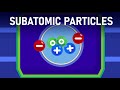
Atoms and Their Subatomic Particles Explained

Interactive Video
•
Physics, Chemistry, Science
•
6th - 8th Grade
•
Practice Problem
•
Hard

Patricia Brown
FREE Resource
Read more
10 questions
Show all answers
1.
MULTIPLE CHOICE QUESTION
30 sec • 1 pt
What is the fundamental building block of all matter?
Compounds
Cells
Atoms
Molecules
2.
MULTIPLE CHOICE QUESTION
30 sec • 1 pt
Which subatomic particle has a negative charge?
Neutron
Proton
Photon
Electron
3.
MULTIPLE CHOICE QUESTION
30 sec • 1 pt
What is the relative mass of a neutron?
2
1
0
1 per 1840
4.
MULTIPLE CHOICE QUESTION
30 sec • 1 pt
Where are protons and neutrons located in an atom?
In the outer shell
Orbiting the nucleus
In the electron cloud
In the nucleus
5.
MULTIPLE CHOICE QUESTION
30 sec • 1 pt
Why is an atom electrically neutral?
Because it has no charged particles
Because it has more protons than electrons
Because it has equal numbers of protons and electrons
Because it has more electrons than protons
6.
MULTIPLE CHOICE QUESTION
30 sec • 1 pt
What does the proton number of an element indicate?
The atomic mass
The number of protons
The number of electrons
The number of neutrons
7.
MULTIPLE CHOICE QUESTION
30 sec • 1 pt
What is another name for the proton number?
Mass number
Atomic number
Electron number
Nucleon number
Access all questions and much more by creating a free account
Create resources
Host any resource
Get auto-graded reports

Continue with Google

Continue with Email

Continue with Microsoft
or continue with

%20(1).png)
Apple

Others
By signing up, you agree to our Terms of Service & Privacy Policy
Already have an account?

