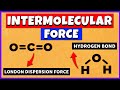
Identifying Intermolecular Forces in Molecules

Interactive Video
•
Chemistry, Science, Biology
•
9th - 12th Grade
•
Practice Problem
•
Hard

Patricia Brown
FREE Resource
Read more
10 questions
Show all answers
1.
MULTIPLE CHOICE QUESTION
30 sec • 1 pt
What type of intermolecular force is primarily responsible for the attraction between water molecules?
Covalent bonding
Ionic bonding
Hydrogen bonding
Metallic bonding
2.
MULTIPLE CHOICE QUESTION
30 sec • 1 pt
Which of the following conditions would result in a nonpolar molecule?
Central atom with no lone pairs and different surrounding atoms
Central atom with lone pairs and identical surrounding atoms
Central atom with no lone pairs and identical surrounding atoms
Central atom with lone pairs and different surrounding atoms
3.
MULTIPLE CHOICE QUESTION
30 sec • 1 pt
What type of intermolecular force is present in a polar molecule?
Dipole-dipole forces and London dispersion forces
Only hydrogen bonding
Only ionic forces
Only London dispersion forces
4.
MULTIPLE CHOICE QUESTION
30 sec • 1 pt
Which intermolecular forces are present in sulfur dioxide?
Only ionic forces
Dipole-dipole forces and London dispersion forces
Only London dispersion forces
Only hydrogen bonding
5.
MULTIPLE CHOICE QUESTION
30 sec • 1 pt
What type of intermolecular force is found in carbon dioxide gas?
Dipole-dipole forces
Hydrogen bonding
Ionic forces
London dispersion forces
6.
MULTIPLE CHOICE QUESTION
30 sec • 1 pt
Which of the following is true for homoatomic molecules like nitrogen gas?
They contain ionic forces
They are nonpolar molecules
They contain hydrogen bonding
They are polar molecules
7.
MULTIPLE CHOICE QUESTION
30 sec • 1 pt
What type of intermolecular forces are present in HCl?
Only ionic forces
Only London dispersion forces
Dipole-dipole forces and London dispersion forces
Only hydrogen bonding
Access all questions and much more by creating a free account
Create resources
Host any resource
Get auto-graded reports

Continue with Google

Continue with Email

Continue with Classlink

Continue with Clever
or continue with

Microsoft
%20(1).png)
Apple

Others
Already have an account?
Similar Resources on Wayground

6 questions
Unlocking the Secrets of Photosynthesis: Towards Cheap Hydrogen Production
Interactive video
•
KG - University
6 questions
Exploring the Intricacies of the Human Sense of Balance
Interactive video
•
KG - University
11 questions
Cellular Respiration and Oxidation Concepts
Interactive video
•
9th - 12th Grade
11 questions
Geometry and Architecture Concepts
Interactive video
•
10th Grade - University
11 questions
The Best Test of General Relativity (by 2 Misplaced Satellites)
Interactive video
•
10th Grade - University
6 questions
CLEAN : Chief of RAF Akrotiri base gives details on UK strikes in Iraq
Interactive video
•
9th - 12th Grade
11 questions
Fukushima Nuclear Disaster Consequences
Interactive video
•
9th - 12th Grade
Popular Resources on Wayground
15 questions
Fractions on a Number Line

Quiz
•
3rd Grade
20 questions
Equivalent Fractions
Quiz
•
3rd Grade
25 questions
Multiplication Facts
Quiz
•
5th Grade
54 questions
Analyzing Line Graphs & Tables
Quiz
•
4th Grade
22 questions
fractions
Quiz
•
3rd Grade
20 questions
Main Idea and Details
Quiz
•
5th Grade
20 questions
Context Clues
Quiz
•
6th Grade
15 questions
Equivalent Fractions
Quiz
•
4th Grade
Discover more resources for Chemistry
20 questions
Types of Chemical Reactions
Quiz
•
9th - 12th Grade
10 questions
Formative 3BC: Ionic v Covalent Bonds
Quiz
•
9th Grade
10 questions
Exploring Stoichiometry Concepts
Interactive video
•
6th - 10th Grade
20 questions
Mixed Bonding Naming
Quiz
•
9th Grade
20 questions
Naming & Writing Chemical Formulas
Quiz
•
10th Grade
20 questions
Chemical Reactions
Quiz
•
9th Grade
20 questions
Practice: E-Con, Orbital Notation, Noble Gas Notation
Quiz
•
10th Grade
20 questions
Covalent Bonding
Quiz
•
10th Grade