
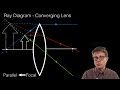
Mastering Ray Diagrams and Lens Behavior in Physics

Interactive Video
•
Physics, Science, Other
•
9th - 12th Grade
•
Practice Problem
•
Hard

Patricia Brown
FREE Resource
Read more
10 questions
Show all answers
1.
MULTIPLE CHOICE QUESTION
30 sec • 1 pt
What type of lens is used to correct near-sightedness?
Converging lens
Cylindrical lens
Diverging lens
Bifocal lens
2.
MULTIPLE CHOICE QUESTION
30 sec • 1 pt
What is the term used to describe the bending of light as it passes from one medium to another?
Diffraction
Dispersion
Refraction
Reflection
3.
MULTIPLE CHOICE QUESTION
30 sec • 1 pt
In a converging lens, what happens to the image when the object is placed beyond the focal point?
The image is virtual and upright
The image is real and inverted
The image is virtual and inverted
The image is real and upright
4.
MULTIPLE CHOICE QUESTION
30 sec • 1 pt
What is the nature of the image formed by a converging lens when the object is inside the focal point?
Virtual and upright
Real and inverted
Virtual and inverted
Real and upright
5.
MULTIPLE CHOICE QUESTION
30 sec • 1 pt
What is the purpose of using a ray diagram in lens analysis?
To measure the speed of light
To locate the position of the image
To determine the type of lens
To calculate the lens thickness
6.
MULTIPLE CHOICE QUESTION
30 sec • 1 pt
What is the key challenge when drawing ray diagrams for converging lenses inside the focal point?
Identifying the lens type
Calculating the lens curvature
Determining the focal length
Finding the virtual image location
7.
MULTIPLE CHOICE QUESTION
30 sec • 1 pt
Which of the following describes the image formed by a diverging lens?
Virtual and inverted
Real and upright
Virtual and upright
Real and inverted
Access all questions and much more by creating a free account
Create resources
Host any resource
Get auto-graded reports

Continue with Google

Continue with Email

Continue with Classlink

Continue with Clever
or continue with

Microsoft
%20(1).png)
Apple

Others
Already have an account?

