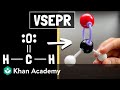
Predicting Molecular Shapes Using VSEPR Theory

Interactive Video
•
Chemistry, Science, Physics
•
9th - 12th Grade
•
Practice Problem
•
Hard

Patricia Brown
FREE Resource
Read more
10 questions
Show all answers
1.
MULTIPLE CHOICE QUESTION
30 sec • 1 pt
What does VSEPR theory help us predict about molecules?
The color of the molecule
The three-dimensional shape of the molecule
The temperature at which the molecule melts
The weight of the molecule
2.
MULTIPLE CHOICE QUESTION
30 sec • 1 pt
In the context of VSEPR theory, what is an electron group?
A single electron
A bond or lone pair of electrons
A molecule
A pair of electrons
3.
MULTIPLE CHOICE QUESTION
30 sec • 1 pt
What is the molecular geometry of methane according to VSEPR theory?
Bent
Linear
Trigonal planar
Tetrahedral
4.
MULTIPLE CHOICE QUESTION
30 sec • 1 pt
How does the presence of a lone pair affect the shape of ammonia?
It changes the shape to trigonal pyramidal
It makes the shape linear
It has no effect on the shape
It makes the shape square planar
5.
MULTIPLE CHOICE QUESTION
30 sec • 1 pt
What is the bond angle in ammonia compared to a perfect tetrahedral angle?
It is larger than 109.5°
It is exactly 109.5°
It is 180°
It is smaller than 109.5°
6.
MULTIPLE CHOICE QUESTION
30 sec • 1 pt
What is the molecular geometry of water?
Linear
Bent
Trigonal planar
Tetrahedral
7.
MULTIPLE CHOICE QUESTION
30 sec • 1 pt
Why is the bond angle in water smaller than in ammonia?
Because water is a larger molecule
Because water has fewer lone pairs
Because water is a smaller molecule
Because water has more lone pairs
Access all questions and much more by creating a free account
Create resources
Host any resource
Get auto-graded reports

Continue with Google

Continue with Email

Continue with Classlink

Continue with Clever
or continue with

Microsoft
%20(1).png)
Apple

Others
Already have an account?
Similar Resources on Wayground

11 questions
Understanding Quaternions
Interactive video
•
10th Grade - University
11 questions
Understanding NMR Spectroscopy
Interactive video
•
10th Grade - University
11 questions
Michael Faraday and Electromagnetism
Interactive video
•
9th - 12th Grade
11 questions
Understanding Heisenberg's Uncertainty Principle
Interactive video
•
10th - 12th Grade
11 questions
Arrhenius Equation and Rate Constants
Interactive video
•
10th - 12th Grade
11 questions
Understanding Electric Circuits and Current
Interactive video
•
10th Grade - University
Popular Resources on Wayground
15 questions
Fractions on a Number Line

Quiz
•
3rd Grade
20 questions
Equivalent Fractions
Quiz
•
3rd Grade
25 questions
Multiplication Facts
Quiz
•
5th Grade
22 questions
fractions
Quiz
•
3rd Grade
20 questions
Main Idea and Details
Quiz
•
5th Grade
20 questions
Context Clues
Quiz
•
6th Grade
15 questions
Equivalent Fractions
Quiz
•
4th Grade
20 questions
Figurative Language Review
Quiz
•
6th Grade
Discover more resources for Chemistry
20 questions
Types of Chemical Reactions
Quiz
•
9th - 12th Grade
20 questions
Energy Transformations
Quiz
•
9th - 12th Grade
20 questions
Periodic Table & Trends
Quiz
•
10th Grade
17 questions
Reaction Rates
Quiz
•
11th Grade
20 questions
Periodic Trends
Quiz
•
10th Grade
24 questions
Identifying Types of Chemical Reactions
Quiz
•
10th - 12th Grade
20 questions
Naming & Writing Chemical Formulas
Quiz
•
10th Grade
20 questions
Atomic Structure
Quiz
•
10th - 12th Grade