
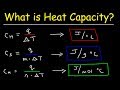
Heat Capacity Versus Specific Heat Capacity: Key Concepts and Calculations

Interactive Video
•
Physics, Chemistry, Science
•
9th - 12th Grade
•
Practice Problem
•
Hard

Patricia Brown
FREE Resource
Read more
10 questions
Show all answers
1.
MULTIPLE CHOICE QUESTION
30 sec • 1 pt
What is the unit of heat capacity?
Joules per Kelvin per gram
Joules per Celsius
Joules per mole per Celsius
Joules per gram per Celsius
2.
MULTIPLE CHOICE QUESTION
30 sec • 1 pt
Which of the following is an extensive property?
Specific heat capacity
Thermal conductivity
Molar heat capacity
Heat capacity
3.
MULTIPLE CHOICE QUESTION
30 sec • 1 pt
Which property is intensive and does not depend on the mass of the substance?
Density
Thermal conductivity
Specific heat capacity
Heat capacity
4.
MULTIPLE CHOICE QUESTION
30 sec • 1 pt
What is the specific heat capacity of water?
0.45 joules per gram per Celsius
1.0 joules per gram per Celsius
4.184 joules per gram per Celsius
2.5 joules per gram per Celsius
5.
MULTIPLE CHOICE QUESTION
30 sec • 1 pt
Why does water have a smaller temperature change compared to iron when the same amount of heat is applied?
Water has a higher specific heat capacity
Iron is a poor conductor of heat
Water has a lower specific heat capacity
Iron has a higher specific heat capacity
6.
MULTIPLE CHOICE QUESTION
30 sec • 1 pt
How does the specific heat capacity of a substance affect its ability to store thermal energy?
Lower specific heat capacity means more energy storage
Higher specific heat capacity means less energy storage
Higher specific heat capacity means more energy storage
Specific heat capacity does not affect energy storage
7.
MULTIPLE CHOICE QUESTION
30 sec • 1 pt
If 1000 joules of heat is applied to 10 grams of iron, what is the temperature change?
50 degrees Celsius
100 degrees Celsius
222.2 degrees Celsius
23.9 degrees Celsius
Access all questions and much more by creating a free account
Create resources
Host any resource
Get auto-graded reports

Continue with Google

Continue with Email

Continue with Microsoft
or continue with

%20(1).png)
Apple

Others
Already have an account?


