
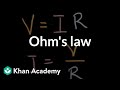
Voltage, Current, and Resistance in Electric Circuits Explained

Interactive Video
•
Physics, Mathematics, Science
•
9th - 12th Grade
•
Practice Problem
•
Hard

Patricia Brown
FREE Resource
Read more
10 questions
Show all answers
1.
MULTIPLE CHOICE QUESTION
30 sec • 1 pt
What is the fundamental relationship between voltage, current, and resistance in an electric circuit?
Voltage is the sum of current and resistance.
Voltage is the product of current and resistance.
Voltage is the difference between current and resistance.
Voltage is the quotient of current and resistance.
2.
MULTIPLE CHOICE QUESTION
30 sec • 1 pt
In the water flow metaphor, what does the potential energy of water represent in an electric circuit?
Power
Current
Resistance
Voltage
3.
MULTIPLE CHOICE QUESTION
30 sec • 1 pt
What does the narrowing of a pipe in the water flow analogy represent in terms of electric circuits?
Resistance
Current
Voltage
Power
4.
MULTIPLE CHOICE QUESTION
30 sec • 1 pt
What is the unit of resistance in an electric circuit?
Volt
Ampere
Ohm
Coulomb
5.
MULTIPLE CHOICE QUESTION
30 sec • 1 pt
In an electric circuit, what happens when the circuit is closed?
The electrons begin to flow.
The voltage increases.
The current stops flowing.
The resistance becomes zero.
6.
MULTIPLE CHOICE QUESTION
30 sec • 1 pt
How is resistance typically represented in a circuit diagram?
With a triangle
With a straight line
With a jagged line
With a circle
7.
MULTIPLE CHOICE QUESTION
30 sec • 1 pt
Using Ohm's Law, how do you calculate the current if the voltage is 16 volts and the resistance is 8 ohms?
1 ampere
2 amperes
8 amperes
4 amperes
Access all questions and much more by creating a free account
Create resources
Host any resource
Get auto-graded reports

Continue with Google

Continue with Email

Continue with Classlink

Continue with Clever
or continue with

Microsoft
%20(1).png)
Apple

Others
Already have an account?

